
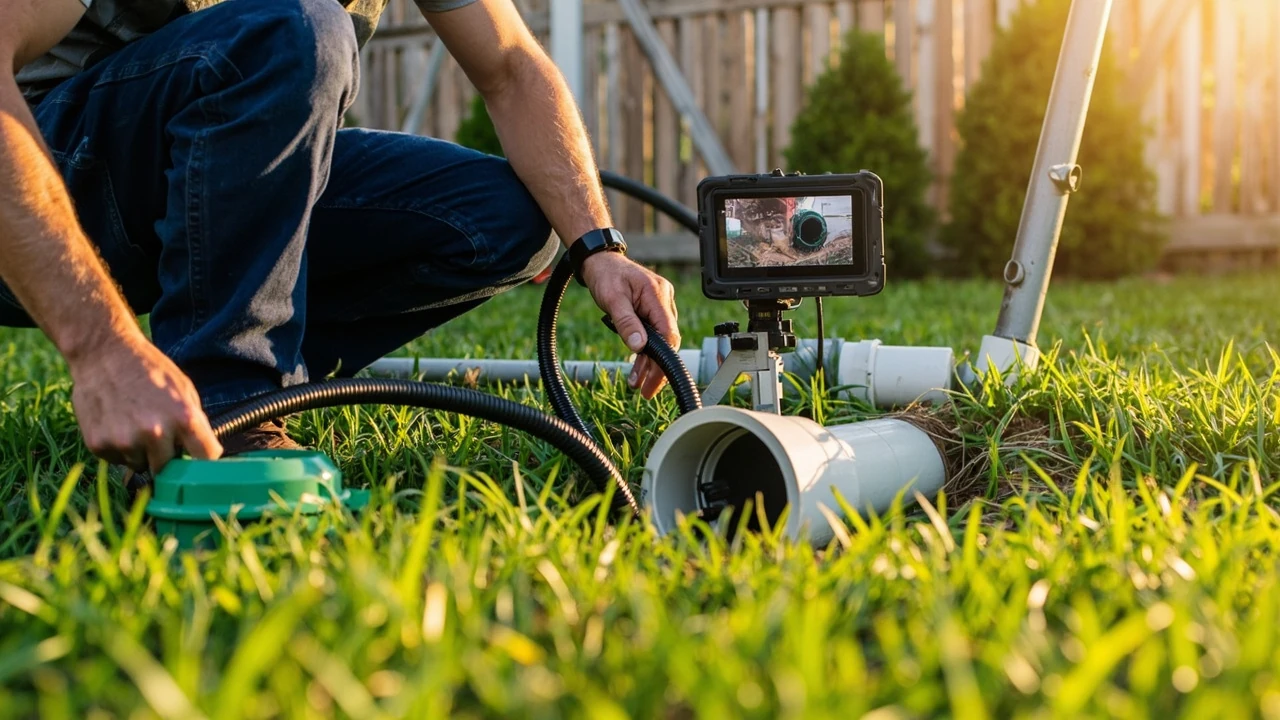
Sewer video inspection: what it shows and when to book one
A sewer video inspection is the single most useful diagnostic step a homeowner can authorize before paying for a sewer repair. Instead of guessing where a clog lives or whether a crack exists, a technician feeds a waterproof camera through the line and records the inside of the pipe on video. The footage tells you, in plain images, whether the problem is roots, a belly, a broken joint, a collapsed section, or simply years of buildup — and it tells a plumber exactly where to dig if digging is needed.
That single piece of information changes almost every decision that follows. It keeps you from paying for a cleanout on a line that needs excavation, from buying a house with a failed clay lateral, and from signing off on a “repair” that only treats the symptom. This guide walks through how the inspection actually works, what it can and cannot show, when it pays for itself, and what to ask the company before you book.
How a sewer video inspection actually works
The process looks simple from the curb, but the equipment is more specialized than a household drain snake. A service truck or van carries a powered reel, a monitor and recording unit, and a camera head built specifically for pipe interiors. Understanding the parts makes the footage easier to read and the invoice easier to evaluate.
The three pieces of equipment on the truck
- Powered reel with push or tractor cable. For most residential lines, the technician uses a semi-rigid push cable that can travel several hundred feet through 2- to 6-inch pipe. For larger municipal lines, a motorized camera tractor is lowered into a manhole and driven through the pipe instead of pushed.
- Camera head with LED lighting and pan/tilt. The head is a sealed cylinder with a high-resolution camera, bright LED lights arranged to avoid glare, and often a transmitter beacon that lets the technician locate the head from above ground. Many modern heads include a sonde — a small radio transmitter — that a locator wand can trace from the surface.
- Monitor, recording unit, and reporting software. The operator watches live footage on a screen in the truck, narrates the run, and saves the video along with on-screen text that shows the distance counter, the pipe material, and any defects. The recording is the deliverable you keep.
Where the camera enters the line
Most residential inspections begin at a cleanout — a capped vertical pipe that rises from the sewer lateral to grade, usually near the foundation or in the front yard. If no cleanout exists, the camera can enter through a pulled toilet, a roof vent, or a removed trap. The cleanout route is the cleanest, fastest, and least likely to leave a mess, which is one reason plumbers recommend adding a cleanout if your home does not have one.
What the operator does during the run
The technician feeds the cable slowly, watching the screen and narrating. The distance counter is reset at the entry point, so every observation is tied to a specific footage mark. When the head reaches the city main, the public tap, or a blockage that stops forward travel, the operator notes the footage, then pulls the head back while continuing to record. Many defects are easier to see on the return pass because the cable is now moving in the direction of normal flow and water tends to drain away from the lens.
What a sewer video inspection can find
The camera does not “test” the pipe in a structural sense; it shows the interior surface and the cross-section. A trained operator reads the image the way a building inspector reads a wall opening. The following defects are the ones a residential inspection most often reveals, and each one implies a different response.
Common findings and what they mean
| Finding on video | What it usually means | Typical next step |
|---|---|---|
| Root intrusion at a joint | Clay or older cast iron segments have separated slightly; roots found the gap | Cable or hydrojet clearing, then a foaming rooticide, with a recheck in 12 months |
| Standing water or “belly” | A section of pipe has settled because the bedding soil shifted, creating a sag | Excavation and re-bedding if the belly is large; otherwise monitoring and routine cleaning |
| Offset joint | Two pipe segments no longer line up; soil movement or settling | Spot repair of that section, or full replacement if offsets are repeated |
| Crack or fracture | Pipe is broken but not yet fully separated | CIPP liner if the crack is isolated; excavation for long or crushed sections |
| Collapse | Pipe wall has failed and is blocking the line | Excavation and replacement of that section |
| Heavy scale or grease | Internal buildup, common in older cast iron or in kitchen lines | Hydrojetting, then a maintenance schedule |
| Inflow at a gasket | Rubber seals have hardened and groundwater is entering the line | Liner or replacement depending on the extent |
What the camera cannot see
- Defects under standing water. If a section is full of water, the lens shows a black screen. The operator may bail the line, jet it first, or report the section as “surcharged” with the exact footage mark so you know the gap in the record.
- Wall thickness or material strength. The image shows the surface, not how much wall remains. A severely corroded cast iron line can look rough but intact, while a thin spot may be invisible until a jetter blasts through it.
- Leaks going out. The camera cannot tell you whether a crack is letting sewage into the soil. A separate hydrostatic test or a smoke test is used for that.
- Code or slope compliance. A camera does not measure slope. The slope has to be inferred from the footage marks, the depth of the pipe at the head, and the distance traveled, and that inference is approximate.
When a sewer video inspection is worth the money
The inspection is not free, and the temptation is to skip it and hope for the best. In a few situations, however, the inspection is essentially required because the cost of guessing is much higher than the cost of the camera. The list below is ordered by how much financial risk the inspection removes.
High-value situations to book an inspection
- Before buying a home. A sewer lateral replacement can run from a few thousand dollars for a short spot repair to well into five figures for a full replacement under a driveway or street. Discovering the condition during escrow lets you negotiate, ask the seller to repair, or walk away.
- Recurring backups in the same fixtures. If the same toilet or floor drain backs up every few months, the cause is structural, not a one-off clog. A camera shows if you are dealing with a belly, a root mass, or a partially collapsed section.
- Before a major landscape or hardscape project. If you are replacing a driveway, building an addition, or installing a pool, knowing the lateral’s path and condition now prevents a costly surprise later when a failure forces excavation through finished work.
- After a major weather event or flood. Saturated soil can shift pipe bedding. An inspection documents baseline condition for an insurance claim and catches early damage.
- Before a real estate transaction on a property built before the 1980s. Older clay and orangeburg laterals are well past their expected service life, and the failure mode is usually a collapse rather than a simple clog.
When an inspection is probably not worth scheduling
A single slow drain in a single fixture, with no history of backups, is almost always a local issue — a trap, a branch line, or a fixture-side clog. A plumber can clear it with a cable or a small drum machine in well under an hour, and a camera run would be overspending. Likewise, a home on a newer PVC lateral that has never had a backup rarely needs a baseline inspection unless the buyer specifically wants documentation.
How much a sewer video inspection costs
Pricing varies by region, by access, and by what is included in the deliverable, but the range below is typical for a single residential run from cleanout to city main. Use it to spot a quote that is suspiciously high or suspiciously low.
Typical residential pricing
| Service element | What it covers | Typical range (USD) |
|---|---|---|
| Standalone camera run | One access point, up to about 200 feet, USB or cloud deliverable | $150 – $400 |
| Camera run included with a clearing | Cable or hydrojet plus a camera pass to verify the result | $300 – $700 |
| Locate and mark | Sonde tracing to mark the head position and depth from the surface | $75 – $200 added |
| Written report with screenshots and distances | PDF report plus video file | Often included; some companies charge $50 – $150 |
| Re-inspection after a repair | Short pass to confirm the fix | $100 – $250 |
Quotes that include a full line clearing plus a camera pass on the same visit are common and often the most cost-effective option because the line is already clean and visible. A standalone “just the camera” quote is appropriate when the line is already known to be clear or when the inspection is for a real estate transaction where you do not want any clearing done before the camera records the actual condition.
What to ask the company before you book
Not every “sewer video inspection” is the same service, and the difference shows up in the deliverable, not the price. A short list of questions separates a useful inspection from a perfunctory one.
Questions that matter
- Will I receive the full video file, not just screenshots? Screenshots are easy to fake and easy to take out of context. A timestamped video lets your own plumber or a second opinion review every foot.
- Is the distance counter shown on the recording? Without footage marks, you cannot tell whether a defect is 30 feet from the cleanout or 90 feet, and that distance determines how invasive any repair will be.
- Will the operator narrate the run, and can I watch live? Most companies will let you stand at the truck and watch. You can ask questions in real time, and the operator’s narration is part of the record.
- Is locating included, and what is the depth limit? The sonde in the head is what lets the technician mark the exact spot and depth of a defect from the surface. Without locating, a dig is still a guess within a few feet.
- Do you provide a written report, and in what format? A one-page PDF with screenshots, distances, and recommendations is standard for real estate and insurance use.
- What is the access plan if there is no cleanout? Some companies will pull a toilet; others will only enter through a cleanout. Knowing this in advance prevents a “we cannot do the job” call after the truck is parked.
How to read the video yourself
You do not need to be a plumber to follow along. The video is a continuous shot of the inside of a pipe, and a few cues tell you almost everything a homeowner needs to know.
Signals to look for on the screen
- Water level. A small trickle of clear water along the bottom of the pipe is normal. Standing water covering the lower third of the screen means a belly or a downstream blockage. The footage mark tells you where.
- Joint appearance. A clean, even joint on PVC is a thin dark line. On clay, the joint should be a narrow gap. If the gap is wide, ragged, or has roots growing out of it, that is a defect.
- Wall color and texture. PVC should be a clean off-white or beige. Cast iron is dark and may have light surface rust. Clay is reddish-brown. Orange or black patches of heavy corrosion, white powdery deposits, or visible flaking are all signs of wear.
- Direction of travel and distance. The on-screen counter resets at the cleanout and counts up. The footage to the city main is a useful comparison: if your lateral is much longer than the distance to the main, the line is wandering or has a belly.
You will also see the head pass through the wye where your house line meets the city main, which is a useful landmark. After that, the pipe belongs to the municipality, and any defects there are usually reported to the local sewer department rather than repaired by a private contractor.
Sewer video inspection versus other diagnostic methods
Camera work is one of several ways to learn the condition of a buried line. Each method answers a slightly different question, and choosing between them depends on what decision you are trying to make.
How the methods compare
| Method | What it shows | Best for | Limitation |
|---|---|---|---|
| Sewer video inspection | Visible interior, joint by joint | Locating defects, planning a repair, real estate due diligence | Cannot see through standing water or below the surface |
| Hydrostatic test | Whether the line holds water under pressure | Identifying leaks before backfill or for slab leak work | Does not show where the leak is |
| Smoke test | Where smoke escapes the system | Finding inflow sources, vent leaks, and yard surcharging | Does not show pipe condition, only openings |
| Sonar or acoustic inspection | Profile of the pipe below water | Surcharged lines that cannot be cleared first | Lower resolution than a camera; specialized equipment |
| Ground-penetrating radar (GPR) | Subsurface utilities and voids | Locating the line itself before excavation | Does not show pipe interior |
For most homeowner decisions, the camera is the starting point. The other methods are used when the camera is inconclusive — for example, when a section is full of water and cannot be cleared first, or when a leak must be confirmed before opening a slab.
How the inspection fits into a real estate purchase
On a home purchase, the sewer lateral is one of the few major systems the standard home inspection does not cover. Sewer lateral inspection is typically arranged separately and is often paid for by the buyer. The deliverable is a video file and a short written report, both of which become negotiating tools.
What to do with the report
- Compare the pipe material to expected life. Clay tile typically lasts 50 to 60 years. Orangeburg, a tar-paper pipe used in some mid-century subdivisions, has a much shorter service life and is considered at end of life at any age.
- Note the depth of the deepest point. Depth drives replacement cost because deeper lines require more excavation and possibly shoring.
- Check for clear encroachment under structures. A line that runs under a slab, a driveway, or a mature tree is more expensive to replace than one that runs through an open side yard.
- Ask the seller to scope the line, or credit the cost of a replacement. In many markets, sellers credit a portion of the lateral cost or arrange the repair before closing.
For a deeper look at what a complementary service covers, the practical walkthrough of what a hybrid service actually covers and when to schedule one shows how multiple systems are sometimes bundled into a single visit, which can be useful when the camera run is being combined with a clearing or a locate. For a complementary maintenance topic on the same system, the sewer line cleaning guide for homeowners covers the cleaning side of the decision once the camera has shown what is actually in the line.
Limits of the inspection and how to handle them
A camera run is a snapshot, not a guarantee. The line you see today is the line as it is today, with the flow conditions and access that exist right now. Three honest limitations are worth keeping in mind before you sign off on a “line looks good” report.
Honest limitations to plan around
- A clear line today can clog tomorrow. Roots grow continuously, and a small intrusion that looks harmless on video can become a blockage within a season. The report should always include a recommended recheck interval for any pipe that is not PVC.
- Wet weather and dry weather look different. Groundwater infiltration only shows up after rain. A dry-weather inspection can miss inflow that appears in spring snowmelt or during heavy storms.
- The end of the run is not always the city main. The technician should mark the footage and the condition at the upstream end. If the run stops short because of a blockage, the report should say so explicitly and recommend a clearing plus a re-inspection rather than declaring the line “good.”
Practical checklist before you book
A short list keeps the appointment efficient and the deliverable useful. Run through the items below when you call for a quote so the company arrives ready and you know what to expect.
- Confirm there is a cleanout, or agree in advance on the access point if there is not.
- Ask whether the price includes the video file, a written report, and a locate with depth.
- Make sure the run will go to the city main, not just to the first bend.
- Plan to be present at the truck for at least part of the run so you can ask questions live.
- Decide in advance whether you want a clearing on the same visit if the camera finds a soft blockage.
- Keep the video file in a safe place; it is your baseline for any future comparison.
A sewer video inspection is most powerful when it is treated as a permanent record rather than a one-time event. The first run establishes a baseline, the second run after a repair confirms the fix, and any future run after a change in symptoms can be compared against the original. Stored next to a closing disclosure or a maintenance file, the video often pays for itself the first time a question comes up about the line.
Frequently asked questions
How long does a residential sewer video inspection take?
Most residential runs take 30 to 90 minutes, including setup, the forward pass, the return pass, and a short conversation at the truck. Older or longer laterals, or lines that need to be jetted first, take longer.
Do I need to be home for the inspection?
You do not need to be in the house, but you should be reachable and ideally present at the truck. Watching the footage in real time lets you ask questions and gives the operator context about the fixtures and any past repairs.
Will the inspection damage my pipes or yard?
The camera itself does not damage pipes when used by a trained operator, and the only access point is the cleanout or a pulled fixture. There is no digging. The push cable is flexible and the head is designed to navigate joints without forcing them.
Can the camera tell the exact depth of a problem?
Yes, if the technician uses a locator. The camera head includes a small transmitter, and a wand traced above the surface pinpoints the horizontal position and the depth. Without a locate, the operator only knows the footage from the cleanout, not the depth.
What if the line is full of water and the camera cannot see?
The operator will report the section as surcharged and note the footage. The next step is usually a clearing — a cable or a hydrojet — followed by a re-inspection. Some companies will jet and camera on the same visit; others will return for a second pass.
Is a sewer video inspection required for a home purchase?
It is not legally required in most jurisdictions, but it is widely recommended for any home built before the 1980s or any home with mature trees near the front yard. The cost is small compared with the cost of an unplanned replacement.
Can a camera inspection find a leak that is letting sewage out?
Usually not directly. A camera shows the surface; it does not measure flow. Outgoing leaks are confirmed with a hydrostatic test or, in some cases, a dye test, while incoming leaks are confirmed with a smoke test.
How often should an older clay or cast iron line be inspected?
A reasonable cadence is every two to three years for clay or older cast iron that has shown any root activity, and every five years for lines that have been cleared and lined. PVC laterals rarely need a recheck unless symptoms appear.
What is the difference between a “locate” and a “camera inspection”?
The camera records the inside of the pipe; the locate uses a transmitter in the camera head to mark the position of the head from above the surface. Most useful inspections include both.
Can the camera go through a full collapse?
No. The camera stops at the collapse, and the footage ends at that point. The report should clearly mark the location and footage of the obstruction so a contractor can plan an excavation and replacement.
Leave a Reply