
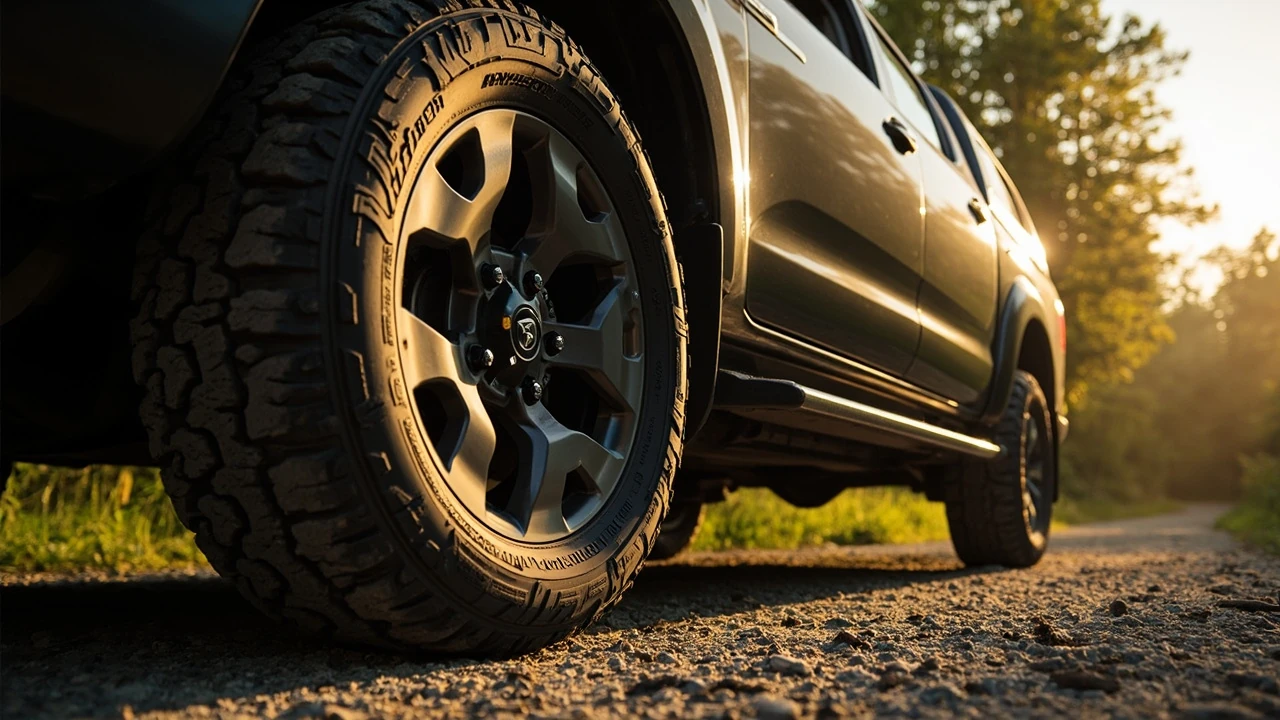
What the Yokohama Geolandar A/T G015 is designed to do
The Yokohama Geolandar A/T G015 sits in the all-terrain category and is aimed at pickups, SUVs, and crossovers that split their miles between paved roads, gravel, light trails, job sites, and winter weather. The compound, symmetric tread pattern, and sidewall design are tuned for that middle ground between a dedicated highway tire and an aggressive mud-terrain tire, with a high-density sipe pattern intended to balance wet grip, snow traction, and tread life on pavement.
Two details are worth keeping in mind before reading product copy. “All-terrain” is a marketing category, not a regulated term, and it spans a wide range of capability. The G015 is sold in P-metric, Euro-metric, LT-metric, and high flotation sizes, and those groups do not all share the same load range, sidewall construction, or warranty terms. The size on the door jamb, not the wheel name in the catalog, is what determines how the tire will behave on a specific vehicle.
Where the Yokohama Geolandar A/T G015 fits in Yokohama’s lineup
Yokohama makes several tires in the Geolandar family, and the letters that follow the name carry real meaning.
- A/T G015: the all-terrain tire, intended for drivers who want balanced on-road manners and usable off-road capability.
- M/T G003: a mud-terrain tire with more aggressive tread blocks, deeper voids, and stronger sidewall lugs, designed for serious off-road use at the cost of on-road comfort.
- H/T G056: a highway-terrain tire aimed at paved-road comfort, longer tread life, and lighter-duty SUVs and crossovers.
- X-CV: a commercial van tire focused on durability and load capacity rather than off-road use.
The G015 is the right pick when an owner regularly leaves pavement but still uses the vehicle as a daily driver. The M/T G003 makes more sense for rock-crawling or muddy trails, and the H/T G056 makes more sense for a suburban SUV that never sees gravel. The question to answer is how often the vehicle leaves paved roads, and how much road noise and reduced fuel economy the owner will accept in exchange for off-road grip.
Size ranges, load ranges, and why the door jamb matters
The G015 is produced in a wide range of sizes to cover everything from half-ton pickups to mid-size crossovers. Within that range, three size groups matter most, and each carries different construction and warranty details.
| Size group | Typical vehicles | Load range | Notes |
|---|---|---|---|
| P-metric and Euro-metric | Mid-size SUVs, crossovers, light-duty pickups | Standard load or XL | Longest mileage warranty tier; tuned for on-road comfort. |
| LT-metric | Three-quarter and one-ton trucks, heavy SUVs | Load range D, E, or F depending on size | Higher load capacity, stiffer sidewalls, slightly shorter warranty mileage. |
| High flotation (metric flotation, 17-inch and larger) | Lifted trucks and SUVs, off-road-oriented builds | Load range C, D, or E | Larger diameter, more aggressive look, often with reinforced sidewalls. |
The load range on the sidewall, the size on the door jamb, and the cold inflation pressure on the same label are the three numbers that should drive any tire decision. A P-metric tire on a half-ton truck that occasionally tows a small trailer is not the same purchase, financially or mechanically, as an LT-metric tire on a three-quarter-ton truck that tows a camper regularly. Before ordering a set of G015s, it is worth confirming the size and load range the vehicle was engineered for, rather than copying whatever is currently mounted, which may reflect a previous owner’s cosmetic preference.
On-road behavior: noise, ride quality, and wet grip
All-terrain tires are noisier than highway tires by design, because the tread blocks that bite into loose surfaces also vibrate against pavement. The G015 is engineered to reduce that noise through a symmetric pattern with varied block sizes and pitch sequencing. Owners generally describe the Yokohama Geolandar A/T G015 as quieter than a typical mud-terrain tire, slightly louder than a dedicated highway tire, and comparable to other modern all-terrain tires in the same size.
Ride quality is influenced more by sidewall construction than by tread pattern. P-metric and Euro-metric sizes use lighter construction and tend to ride more smoothly. LT-metric sizes, especially in higher load ranges, transmit more impact harshness over sharp bumps because the sidewalls and ply package are stiffer. Drivers moving from P-metric to LT-metric on the same vehicle often notice the change immediately, and it is worth weighing before selecting a size.
Wet grip on the G015 comes from circumferential grooves, lateral grooves, and a high-density sipe pattern on the tread blocks. The tire carries a UTQG (Uniform Tire Quality Grading) treadwear rating printed on the sidewall, and traction and temperature grades are available in the manufacturer’s literature. Those grades are standardized tests, not real-world guarantees, and they read more usefully as relative comparisons within the all-terrain category than as absolute performance numbers.
Off-road behavior: gravel, mud, sand, and rocks
The G015 is not a mud-terrain tire, and the difference shows up the moment the surface turns soft. On graded gravel roads, fire roads, and dry two-tracks, the tire performs well: the tread blocks provide bite, the voids clear small stones, and the sidewall lugs protect against scraping on rocks. On deep mud, the voids are not as open as on a dedicated M/T tire, so the tire will pack up and lose traction sooner. Self-cleaning ability is decent for the category but not exceptional.
Sand driving depends heavily on tire pressure. Lowering cold pressure to roughly 18 to 22 psi for airing down improves the contact patch, and the rounded shoulder blocks help maintain float. Owners who routinely drive on soft sand should plan to carry a portable compressor and to reinflate before returning to paved roads at speed. Rocks and ruts are where the sidewall lugs earn their keep, but it is important to remember that only the LT-metric sizes are engineered for repeated low-pressure off-road use, and even then, airing down below the manufacturer minimum increases the risk of bead damage.
Winter performance and the three-peak mountain snowflake
Many G015 sizes carry the three-peak mountain snowflake symbol, which indicates that the tire meets a defined traction threshold in standardized snow testing. Sizes that carry the symbol are considered severe snow service rated and are accepted by some state and provincial jurisdictions that require winter-rated tires in certain conditions. Sizes that do not carry the symbol are still all-season rated for light winter use but are not considered dedicated winter tires.
For owners in regions with regular snow and ice, the three-peak snowflake sizes are a reasonable choice for a year-round tire. For owners in regions with prolonged deep snow, mountain passes, or icy rural roads, a dedicated winter tire set on separate wheels remains a safer and quieter option, and the G015 is not designed to replace that.
Tread life and the warranty, explained in plain language
Yokohama’s published warranty for the Yokohama Geolandar A/T G015 separates P-metric and Euro-metric sizes from LT-metric and high flotation sizes. The P-metric and Euro-metric sizes carry a 60,000-mile limited treadwear warranty, and the LT-metric and high flotation sizes carry a 50,000-mile limited treadwear warranty. There is also a 30-day trial satisfaction guarantee, which allows the original purchaser to exchange the tires under defined conditions within the first 30 days if they are not satisfied.
Two details in the warranty language are easy to overlook. The first is the time limit: warranty coverage extends for the life of the original usable tread depth, defined as the depth down to the treadwear indicator bars at 2/32 inch, or for 60 months from the date of purchase with proof, or 72 months from the date of manufacture if no proof of purchase is available, whichever comes first. The second is transferability: the warranty applies to the original purchaser and is not transferable. If a vehicle is sold with the tires already mounted, the new owner does not inherit the mileage warranty, only the remaining time window if proof of purchase from a Yokohama-authorized dealer can be produced.
Warranty claims also require the tires to be used in normal highway service. Commercial applications are excluded, and tires that become unserviceable because of neglect, mistreatment, improper inflation, alignment problems, or mechanical issues with the vehicle are not covered. That is standard language across the industry, but it matters when comparing mileage promises from different brands: realized tread life often depends as much on rotation intervals, alignment, and inflation habits as on the tire itself. The full policy is spelled out in Yokohama’s official documentation for the model, and it is worth reading before purchase rather than after a problem appears.
What to check before you mount the G015
Even with the right tire, a poor install can shorten life, hurt ride quality, or create a safety issue. The list below covers the checks that matter most.
- Confirm the size and load range on the door jamb. Do not rely on the size currently mounted, and do not assume a plus-size fitment is appropriate without checking clearances and load rating.
- Inspect the wheels. All-terrain tires are heavier than highway tires, and any wheel corrosion, cracks, or out-of-round conditions should be addressed before mounting.
- Replace the valve stems. Rubber valve stems on a tire this heavy are a small item but a real source of slow leaks. New stems should be installed with every new tire.
- Check the TPMS sensors. If the vehicle has a tire pressure monitoring system, the sensors are usually serviceable but can be damaged during demount. Confirm condition and replace batteries where applicable.
- Request a road force balance. All-terrain tires with stiffer sidewalls benefit from road force balancing more than passenger tires, and a good balance reduces vibration at highway speed.
- Set cold inflation to the door-jamb pressure, not the maximum on the sidewall. The maximum on the sidewall is a structural limit, not a target. The door-jamb pressure is what the vehicle manufacturer recommends for normal load.
- Have an alignment checked. If the previous tires showed uneven wear, an alignment check before mounting the new tires avoids paying to wear out a fresh set in the same pattern.
- Plan a rotation schedule. Rotation every 5,000 to 7,500 miles extends life and keeps the warranty record consistent.
Common mistakes owners make with the G015
Most of the disappointment reported with the Yokohama Geolandar A/T G015 comes down to a small number of recurring mistakes. Over-inflation is the most common. Drivers who inflate to the maximum pressure printed on the sidewall often report a harsh ride, reduced wet grip, and uneven center wear. The second most common mistake is mixing P-metric and LT-metric sizes on the same axle, which changes the loaded radius and can trigger ABS or stability control behavior. The third is treating the warranty as a mileage guarantee rather than as a prorated adjustment policy. The warranty provides credit toward a replacement based on remaining usable tread, not a free set of new tires at the end of the stated mileage.
The fourth mistake is assuming the three-peak snowflake symbol is the same as a studdable winter tire. It is not. The symbol indicates a passing score on a standardized snow test, and the G015 is not designed to be studded and is not a substitute for a dedicated winter tire in heavy snow or on glare ice.
How the G015 compares to other tires in the category
The all-terrain segment is competitive, and the G015 is regularly compared to the BFGoodrich All-Terrain T/A KO2, the Falken Wildpeak A/T, the Toyo Open Country A/T III, the General Grabber AT3, and the Goodyear Wrangler All-Terrain Adventure. Differences between these tires are usually small for most owners and large for specific use cases.
| Consideration | What the Yokohama Geolandar A/T G015 emphasizes | What to check on competitors |
|---|---|---|
| Mileage warranty | 60,000 miles on P-metric sizes, 50,000 on LT-metric | Some competitors publish 50,000 or 55,000 across all sizes; others publish 60,000 or 65,000 on LT sizes. |
| Sidewall design | Sidewall lugs for light off-road use, less aggressive than M/T tires | Some competitors offer more aggressive sidewall options for rock protection. |
| Winter rating | Three-peak snowflake on most sizes | Confirm symbol presence on the specific size, not just the model line. |
| On-road noise | Symmetric pattern tuned for reduced noise | Subjective comparison; only a test drive on familiar roads gives a reliable answer. |
| Price tier | Mid-range for the category | Compare installed price, not sticker price, including road force balance and any required TPMS service. |
The honest answer to “is the G015 better than tire X” is that it depends on the size, the use case, and the driver’s priorities. For a daily-driven half-ton truck used on a mix of highway and light trails, the Yokohama Geolandar A/T G015 is a balanced choice. For a dedicated work truck towing heavy loads, an LT-metric size with a higher load range may matter more than the brand. For a rock-crawler, none of the all-terrain tires in the category are the right answer.
When the G015 is not the right tire
Three situations call for a different tire. The first is severe winter driving in regions with months of snow and ice; a dedicated winter tire is safer and quieter. The second is heavy-duty off-road use on technical terrain, deep mud, or sharp rock, where a mud-terrain tire or a dedicated off-road tire will last longer and protect the vehicle better. The third is commercial fleet use on trucks that see constant heavy loads and long highway miles; a commercial-grade highway tire is engineered for that workload and will deliver better value.
Frequently asked questions
What is the mileage warranty on the Yokohama Geolandar A/T G015?
The published warranty is up to 60,000 miles for P-metric and Euro-metric sizes, and up to 50,000 miles for LT-metric and high flotation sizes. Warranty coverage also has a time limit of 60 months from purchase with proof, or 72 months from manufacture without proof, and applies to the original purchaser only.
Does the G015 come with a 30-day trial?
Yes, Yokohama offers a 30-day trial satisfaction guarantee on the Yokohama Geolandar A/T G015. The exact terms, exchange conditions, and participating dealers are described in the official warranty documentation for the tire.
Are all G015 sizes three-peak mountain snowflake rated?
No. The three-peak mountain snowflake symbol is printed on specific sizes only. Before purchasing, confirm that the exact size and load range ordered carries the symbol if winter-rated performance is required.
Can the G015 be used in deep snow or on ice?
Three-peak snowflake sizes are designed for severe snow service and perform well in moderate winter conditions. For prolonged deep snow, mountainous driving, or glare ice, a dedicated winter tire remains a safer choice.
What is the difference between P-metric and LT-metric G015 sizes?
P-metric and Euro-metric sizes are tuned for on-road comfort and carry a longer mileage warranty. LT-metric sizes are engineered for higher load capacity, stiffer sidewalls, and heavier use, with a slightly shorter mileage warranty. The door-jamb label is the correct reference for which size the vehicle requires.
How often should G015 tires be rotated?
A rotation every 5,000 to 7,500 miles is a reasonable interval. Vehicles with significant front-to-rear wear differences, such as front-wheel-drive crossovers or heavily loaded trucks, may benefit from the shorter end of that range.
Is the G015 noisy on the highway?
It is louder than a dedicated highway tire and quieter than a typical mud-terrain tire. The actual cabin noise depends on the vehicle, the size, and the inflation pressure. Lowering cold inflation to the door-jamb recommendation typically reduces noise compared to inflating to the maximum on the sidewall.
Can the G015 be studded?
The G015 is not designed or approved for studding. Studs damage the tread compound and void the warranty. In jurisdictions that allow studs, a dedicated winter tire is the appropriate choice.
Does the warranty transfer when a vehicle is sold?
No. The mileage warranty applies to the original purchaser only and is not transferable. The remaining time window may still apply if proof of purchase from a Yokohama-authorized dealer is available.
What should cold inflation pressure be on the G015?
Use the pressure on the vehicle’s door-jamb label for normal load, and adjust upward for heavy loads according to the same label or the owner’s manual. The pressure printed on the tire sidewall is a structural maximum, not a target inflation pressure.
Related reading on the site
Two articles on this site cover related topics that often come up around the same kind of upgrade decision. Security Systems for Home: What Actually Matters in 2026 walks through the tradeoffs between different security setups in a similar, evidence-based way, and Garage Door Cable Replacement: A Practical Homeowner Guide covers a maintenance decision that, like a tire upgrade, depends on matching the right part to the right vehicle.
Leave a Reply