
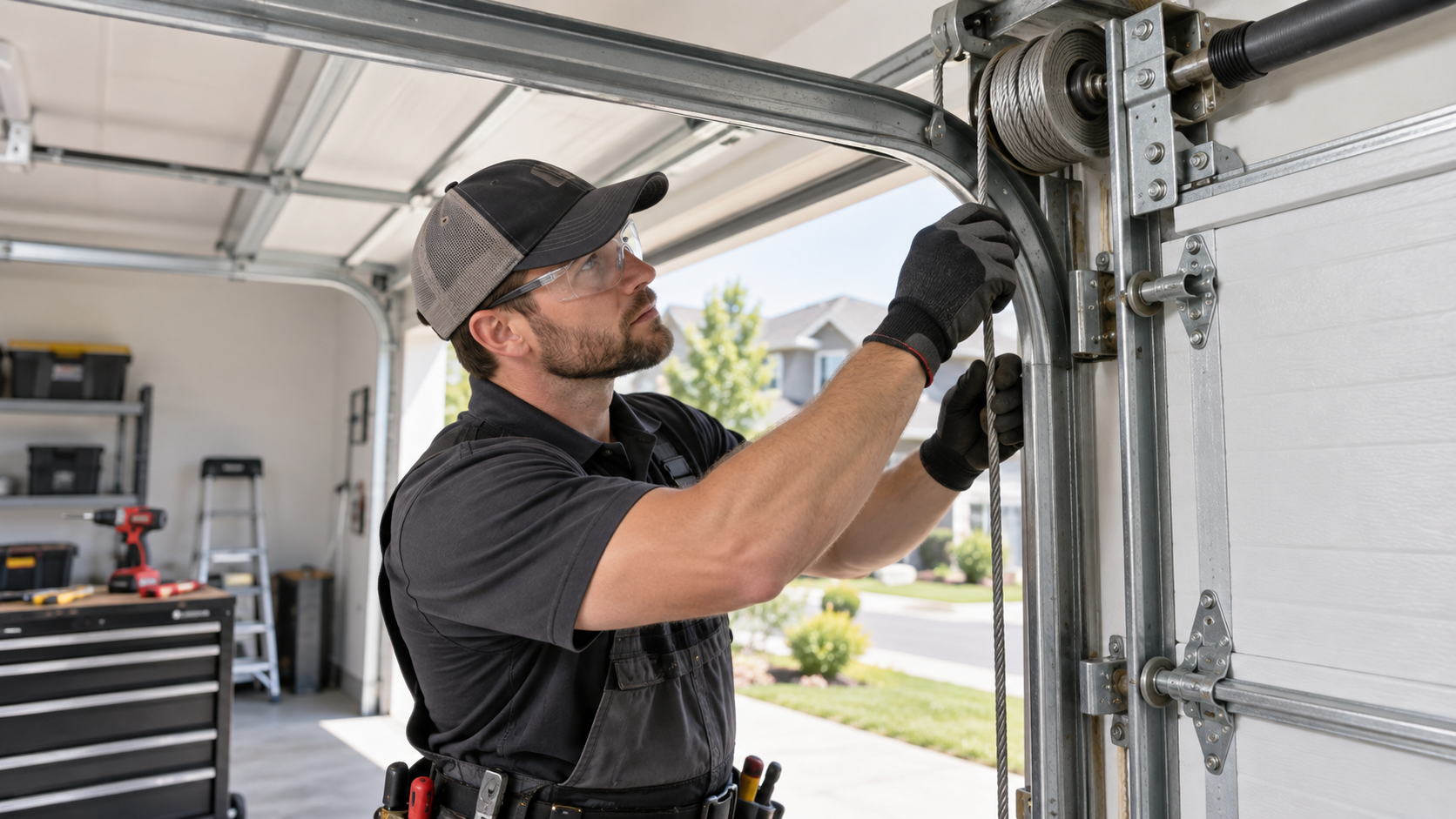
You press the garage door opener and expect the usual routine. The motor hums, the door rises, and you get on with your day.
Then one morning, something looks off.
One side of the door hangs lower than the other. A thin steel cable is dangling near the track. Maybe the door starts moving and suddenly stops. Or you hear a sharp snap that definitely does not sound normal.
At that point, garage door cable replacement quickly moves from “something I should check someday” to “okay, what happened here?”
Garage door cables are small compared with the door itself, but they play a major role in lifting and lowering hundreds of pounds safely. When one fails, the door may become crooked, jammed, unusually heavy, or unsafe to operate.
And there is an important detail homeowners should know right away: cables work alongside a spring system that can store a large amount of energy. This is not the same kind of DIY job as tightening a cabinet hinge or replacing weather stripping.
Here is what garage door owners in the United States should know about cable problems, repairs, costs, maintenance, and when professional help makes sense.
What Do Garage Door Cables Actually Do?
A typical garage door is much heavier than it feels when everything is working correctly.
The reason it moves so easily is that the spring and cable system helps balance that weight.
The cables are usually made from braided steel wire. They connect parts of the door to drums, springs, or other lifting hardware depending on the type of garage door system.
As the door moves, the cables help keep the door level while transferring the force needed to raise and lower it.
Think of them as part of a carefully balanced lifting system. The opener does not simply drag the full weight of the door upward by itself.
When a cable becomes damaged or breaks, that balance can disappear almost instantly.
Common Types of Garage Door Cables
Not every garage door uses exactly the same hardware.
The cable arrangement depends mainly on the spring system.
| Garage Door System | Cable Location | Main Function |
|---|---|---|
| Torsion spring system | Runs from the bottom bracket to cable drums near the top | Helps lift and lower the door evenly |
| Extension spring system | Runs along the tracks and works with extension springs | Transfers spring force to the door |
| Safety cable | Runs through or alongside extension springs | Helps contain a spring if it breaks |
Torsion spring systems are common in many modern residential garages. You will usually see a metal shaft and one or more springs mounted above the door.
Extension spring systems typically have springs running along the horizontal tracks on either side.
The distinction matters because the repair method, hardware, cable length, and tensioning process are not identical.
Signs You May Need Garage Door Cable Replacement
Cable failure is not always subtle.
Sometimes the signs are obvious. Other times the door keeps working for a while, which makes the problem easy to ignore.
Watch for symptoms such as:
- One side of the garage door sits lower than the other
- A cable is hanging loose beside the track
- The door rises unevenly
- The door suddenly feels much heavier
- The opener struggles or stops while lifting
- A cable has visible fraying or broken strands
- The cable has slipped off a drum
- The door becomes stuck partway open
- You hear a sharp snapping or whipping sound
- The bottom section of the door appears twisted or uneven
If one of these happens, stop repeatedly operating the door.
Continuing to cycle a damaged system can turn a relatively contained cable issue into damaged tracks, bent panels, stressed opener hardware, or additional broken components.
What Does a Frayed Garage Door Cable Look Like?
A healthy garage door cable should look relatively uniform along its length.
Fraying often appears as small individual steel strands sticking outward from the cable.
At first, it may look like a tiny metal splinter.
Over time, more strands can break.
Rust can also appear, particularly near the lower part of the door where moisture, road salt, wet leaves, and garage-floor water tend to collect.
Do not run your bare fingers along a frayed cable. Those tiny steel strands can be surprisingly sharp.
A cable showing significant broken strands should normally be evaluated before it fails completely.
Why Garage Door Cables Break
Garage door cables are durable, but they are not permanent.
They move every time the door opens and closes, often thousands of times over their service life.
Several things can eventually weaken them.
Normal Wear
Repeated bending and tension gradually fatigue steel strands.
If your garage door is used several times a day, that adds up quickly over the years.
Corrosion
Moisture is rough on steel.
Garages in humid climates or areas where winter road salt gets tracked indoors can be especially hard on lower door hardware.
Damaged Cable Drums
If a drum is worn, cracked, misaligned, or damaged, the cable may not wind correctly.
That can create uneven loading and premature wear.
Improper Door Balance
If the spring system is not carrying the door correctly, the cables can experience unusual loads.
A cable failure may therefore be a symptom of another mechanical problem rather than an isolated issue.
Cable Jumping Off the Drum
A cable can sometimes come off the drum without actually breaking.
This may happen if the door becomes obstructed, moves unevenly, or loses proper tension.
The cable may then become tangled or kinked.
Should Both Garage Door Cables Be Replaced?
This is a common question.
If one lifting cable fails from normal wear and both cables are the same age, a technician may recommend replacing them as a pair.
There is a practical reason.
The remaining cable has experienced roughly the same number of door cycles and environmental exposure as the failed one.
Replacing only the broken cable may leave another heavily worn cable in service.
That does not mean every repair automatically requires replacing everything.
A technician should inspect the condition of both sides and the rest of the lifting system before making that decision.
Can You Still Open the Garage Door With a Broken Cable?
Sometimes the door may still move.
That does not mean it is safe to keep operating.
A single broken cable can cause the door to lift unevenly. One side may rise while the other drags behind.
The result can be a door that binds in the tracks or becomes badly crooked.
If the door is partly open when the cable fails, there is also a risk of unexpected movement.
The safer response is usually to stop using the opener and have the door inspected.
Do not stand underneath a door that appears unstable.
Why Garage Door Cable Replacement Can Be Dangerous
The cable itself is only part of the issue.
The bigger concern is what it is connected to.
Garage door spring systems can store substantial mechanical energy. Cable drums, bottom brackets, springs, and related hardware may be under tension even when the door is not moving.
That is why repair technicians use specific procedures and tools to control the system before removing parts.
The danger is not just getting pinched.
A released spring, cable, winding bar, bracket, or moving door can cause serious injury.
For homeowners, visual inspection is reasonable. Working on loaded spring hardware is a very different matter.
Why the Bottom Bracket Deserves Extra Respect
At the bottom corners of many sectional garage doors, the lifting cables attach near brackets connected to the door.
These brackets may be under cable tension.
Removing bolts from the wrong bracket while the system is loaded can release force unexpectedly.
If you see a loose cable near the bottom corner of the door, avoid assuming that the bracket itself is safe to remove.
This is one of those situations where something can look mechanically simple while actually being part of a loaded system.
What a Professional Cable Repair Usually Involves
The exact repair depends on the spring system and what caused the failure.
A technician normally starts by inspecting the complete door rather than simply attaching another cable and leaving.
That inspection may include:
- Checking both lifting cables
- Inspecting drums and pulleys
- Checking spring condition
- Inspecting bottom brackets
- Looking for bent tracks
- Checking door alignment
- Testing rollers and hinges
- Evaluating door balance
- Confirming cable routing
- Testing the opener after mechanical repairs
The door then needs to be returned to proper balance and tested through its travel.
That last part matters.
A new cable does little good if the underlying reason it failed is still there.
Garage Door Cable Replacement vs. Cable Reset
Not every loose cable is broken.
Sometimes the cable has simply come off the drum.
That might sound like good news, and sometimes it is.
But the reason it came off matters.
A cable can jump because the door encountered an obstruction, the spring tension changed, the door went crooked, the drum shifted, or another part of the system developed a problem.
Simply putting the cable back without diagnosing the cause may lead to the same problem again.
If a cable has become badly kinked, flattened, or damaged after coming off the drum, replacement may make more sense than reusing it.
How Much Does Garage Door Cable Replacement Cost?
There is no single nationwide price.
Labor rates vary considerably across the United States, and the final bill depends on the door design, spring system, number of cables replaced, local service rates, and whether other damaged parts are found.
A straightforward cable repair is usually far less expensive than replacing an entire garage door.
But a quote may rise if the technician also discovers damaged drums, worn pulleys, broken springs, bent tracks, or other components that contributed to the failure.
| Factor | How It Can Affect the Job |
|---|---|
| One cable vs. two cables | Replacing a pair usually means more parts and labor |
| Spring system type | Torsion and extension systems require different procedures |
| Door size and weight | Larger or heavier doors may require different cable specifications |
| Emergency service | Nights, weekends, or same-day calls may cost more |
| Additional damaged hardware | Drums, springs, pulleys, brackets, or tracks can increase repair cost |
| Local labor rates | Pricing varies between cities and regions |
Ask for the total repair price before approving the work.
Also ask whether the quote includes parts, labor, service fees, and any warranty.
What Should You Ask a Garage Door Technician?
You do not need to know the technical name of every part.
A few simple questions can tell you a lot.
Ask what caused the cable failure.
Ask whether the second cable shows wear.
Ask whether the springs, drums, pulleys, tracks, and bottom brackets look normal.
Ask whether the door is properly balanced after repair.
And ask what warranty applies to the work.
A good technician should be able to explain the problem in plain English.
Can a Garage Door Opener Cause Cable Problems?
Indirectly, yes.
The opener is not supposed to compensate for a poorly balanced door.
If a door becomes mechanically difficult to move but the opener keeps forcing it through each cycle, stress can increase across several components.
The opener may strain, the door may rack sideways, or other hardware may wear faster.
A garage door that suddenly becomes heavy or uneven should be treated as a mechanical issue first.
Do not simply increase opener force settings and hope the problem disappears.
What Happens If You Ignore a Damaged Cable?
Usually nothing good.
A partially frayed cable may continue working for a while.
Then another strand breaks.
Then another.
Eventually the remaining strands may no longer carry the load.
If the cable fails while the door is moving, one side can lose support and the door may twist or jam.
That can damage rollers, tracks, panels, drums, or the opener.
A small repair can become a much larger one.
How to Reduce Cable Wear
No maintenance routine can make cables last forever.
But regular observation can help catch trouble early.
Every few months, take a quick look at the visible door hardware while the door is stationary.
You are looking for obvious changes.
- Frayed cable strands
- Rust or corrosion
- Loose-looking cable sections
- Cables rubbing against another component
- Uneven cable winding on drums
- A door that no longer sits level
- New scraping or grinding noises
- Unusual shaking during operation
- Loose or damaged rollers and hinges
Do not attempt to adjust loaded springs or cable hardware during the inspection.
The goal is to notice problems, not create a new one.
Weather Can Affect Garage Door Hardware
Garage doors live in a rough environment.
They sit between indoor and outdoor conditions all year.
In northern states, road salt and snowmelt can collect around the bottom of the door.
In coastal areas, salty air can accelerate corrosion.
Hot, humid garages can also be hard on steel components.
If the lower hardware on your garage door regularly gets wet, pay a little extra attention to corrosion around cables and brackets.
What About Lubrication?
Garage door maintenance often includes lubrication of certain moving components, but cable replacement is not simply a lubrication issue.
Spraying lubricant on a severely frayed cable does not restore broken steel strands.
It also does not correct poor alignment, damaged drums, or incorrect spring balance.
If you notice physical cable damage, treat it as a mechanical inspection issue rather than trying to spray the problem away.
When Should the Entire Garage Door Be Replaced?
A broken cable alone usually does not mean you need a new garage door.
Cables are replaceable service components.
Full door replacement becomes more relevant when the door itself has major damage, severe rust, cracked sections, significant structural deterioration, or multiple costly problems.
For an otherwise solid door, repairing the lifting system is usually the more sensible approach.
If your garage door is very old, though, ask the technician to assess the overall system.
Sometimes repeated repairs start costing enough that replacement deserves consideration.
What If the Cable Broke While the Door Is Closed?
A closed door is usually a better situation than a door stuck halfway up.
But the door can become extremely heavy if the lifting system is compromised.
A person may be tempted to disconnect the opener and lift the door manually.
Be careful with that idea.
A heavy garage door can move unpredictably when spring or cable support is missing.
If the door feels unusually heavy, crooked, or unstable, do not force it upward.
What If the Door Is Stuck Open?
This situation deserves more urgency because an open garage affects security and may leave an unstable door overhead.
Keep people, pets, and vehicles away from the door if it looks crooked or unsupported.
Do not stand under it while trying to diagnose the cable.
A garage door technician can secure the system before moving the door.
Garage Door Cable Replacement FAQ
How do I know if my garage door cable is broken?
Common signs include a loose or hanging cable, uneven door movement, one side sitting lower, a door that suddenly feels heavy, or visible fraying. A sharp snapping sound can also indicate cable failure.
Can I use my garage door with one broken cable?
It is better not to. The door may lift unevenly and can jam, twist, or damage other hardware. Continuing to operate the opener can make the problem worse.
Should both garage door cables be replaced at the same time?
If both cables are the same age and one failed from normal wear, replacing them as a pair is often considered. A technician should inspect both sides before recommending the repair.
Can a garage door cable be repaired instead of replaced?
A frayed or broken lifting cable is generally replaced rather than patched. A cable that has simply come off a drum may sometimes be reset if it is undamaged and the underlying cause is corrected.
How long does garage door cable replacement take?
A straightforward professional repair can often be completed during one service visit. Timing depends on the door system, accessibility, and whether additional damaged parts are found.
Why did my garage door cable come off the drum?
Possible causes include uneven door movement, loss of tension, obstruction, spring problems, damaged drums, or a door that became misaligned. The cause should be checked before the cable is returned to service.
Is garage door cable replacement a DIY job?
It can involve components under substantial spring tension. Because unexpected release of that energy can cause serious injury, many homeowners prefer to have lifting cables and related spring hardware serviced by a trained garage door technician.
Conclusion
Garage door cables are easy to overlook when everything is working.
They are thin, mostly hidden, and far less noticeable than the door panels or opener hanging from the ceiling.
But they are doing serious work every time the door moves.
If a cable frays, slips, or breaks, the safest response is to stop repeatedly operating the door and look at the entire lifting system rather than treating the cable as an isolated piece of wire.
A professional garage door cable replacement should include more than simply installing a new cable.
The technician should determine why the failure happened.
Was the cable simply worn out?
Did corrosion weaken it?
Did a drum fail?
Is the spring system out of balance?
Did the door become crooked before the cable came off?
Those questions matter because replacing a cable without addressing the cause can lead to another failure.
Homeowners can still play an important role.
Look at the cables occasionally.
Watch for broken strands, rust, unusual slack, or uneven movement.
Pay attention when the door suddenly sounds different or begins shaking.
Small changes often appear before a complete failure.
And resist the urge to keep pressing the opener button when the door is obviously struggling.
The opener cannot fix a mechanical problem. It can only keep pushing against it.
There is also no prize for turning every home repair into a DIY project.
Garage doors combine heavy moving panels with springs and cables that can be under significant tension. Some maintenance tasks are simple. Loaded lifting hardware deserves more caution.
If the door is crooked, stuck, unusually heavy, or has a broken lifting cable, keeping people away from it and arranging an inspection is a sensible move.
For most homeowners, garage door cable replacement is a relatively small repair when it is caught early.
Ignore it, though, and one damaged cable can start affecting tracks, rollers, drums, panels, springs, and even the opener.
So if something suddenly looks wrong at the side of your garage door, do not just tuck the loose cable out of sight and hope for the best.
That little steel cable is carrying more responsibility than it looks like.
Leave a Reply