
A slow bathroom sink is annoying. A toilet that needs a second flush is annoying too. But when several drains in the house start acting strange at the same time, the problem may be farther down the plumbing system than you think.
That is where sewer line cleaning comes into the picture.
Your home’s main sewer line carries wastewater away from toilets, sinks, showers, tubs, washing machines, and other plumbing fixtures. Most days, it quietly does its job without getting much attention. Then water starts bubbling in the shower when somebody flushes upstairs, or the basement floor drain suddenly smells worse than usual.
Not exactly the kind of household surprise anyone wants.
Main sewer problems can come from grease, wipes, tree roots, mineral buildup, damaged pipe sections, foreign objects, or years of accumulated debris. Sometimes the line is simply dirty. Other times cleaning reveals a deeper structural issue.
The key is figuring out which situation you have before a small drainage problem becomes a sewage backup across the bathroom floor.
What Is Sewer Line Cleaning?
Sewer line cleaning means removing material that restricts wastewater flow through the main drain or sewer pipe connected to a home.
This is different from clearing a small clog directly under a kitchen sink.
A local fixture blockage may affect one sink or one toilet. A problem in the main sewer line can affect several fixtures throughout the house because all those smaller drain lines eventually connect to the same larger pipe.
Professional cleaning may involve mechanical drain equipment, high-pressure water cleaning, camera inspection, or a combination of methods.
The right method depends on what is inside the pipe and what condition the pipe is in.
How Your Home’s Drain System Fits Together
Think of the plumbing system like a road network.
Small neighborhood streets lead into larger roads. Those larger roads eventually connect to the main route out of town.
Your sinks, tubs, toilets, dishwasher, and washing machine each connect to smaller drain pipes. Those pipes feed into larger branches, which ultimately connect to the building’s main sewer line.
When one small branch gets blocked, you may notice trouble in one room.
When the main line becomes restricted, problems can show up all over the house.
Signs Your Main Sewer Line May Need Attention
One slow drain does not automatically mean you need sewer line cleaning.
Several symptoms happening together are more concerning.
- Multiple drains are slow at the same time
- Toilets bubble or gurgle when another fixture drains
- Water rises in a shower or tub when a toilet is flushed
- Water appears around a basement or utility-room floor drain
- Several toilets begin flushing poorly
- Drain odors become noticeable in multiple areas
- A lower-level drain backs up when the washing machine runs
- The plumbing makes new gurgling sounds
- Wastewater returns through a low drain
If sewage is actively backing into the home, stop using water wherever practical until the problem is evaluated.
Continuing to run showers, toilets, washing machines, or dishwashers can send more wastewater toward a line that is already blocked.
One Slow Drain or a Main Sewer Problem?
This distinction saves a lot of confusion.
| What You Notice | More Likely Possibility |
|---|---|
| One bathroom sink drains slowly | Local sink trap or branch-line clog |
| One shower drains slowly | Hair or soap buildup near that fixture |
| Several fixtures become slow together | Larger branch or main sewer restriction |
| Toilet flush makes water rise in the tub | Possible downstream drain or sewer blockage |
| Basement drain backs up when upstairs water runs | Possible main sewer line restriction |
| Recurring problems after repeated drain clearing | Possible deeper blockage or pipe defect |
Plumbing is not always perfectly predictable, so these patterns are clues rather than a diagnosis.
Still, the more fixtures involved, the more reason there is to look beyond a simple sink clog.
What Causes Sewer Line Blockages?
Main sewer lines deal with a surprising amount of material over the years.
Even when everybody in the house is fairly careful, buildup can still develop.
Grease and Food Residue
Cooking grease may look harmless while it is hot and liquid.
Once it cools inside a pipe, it can stick to the walls and trap other debris. Bit by bit, the open space inside the pipe gets smaller.
This can be especially troublesome in kitchen drain systems.
So-Called Flushable Wipes
Toilet paper is made to break apart relatively quickly in water.
Many wipes behave differently.
They may stay intact much longer, catch on rough areas inside pipes, and combine with grease or other debris.
Paper towels, sanitary products, cotton swabs, and similar items can cause the same kind of trouble.
Tree Roots
Older sewer lines can sometimes develop small openings at joints or damaged sections.
Roots naturally grow toward moisture. If they enter through an opening, they can continue growing inside the pipe and catch passing waste.
A small intrusion can eventually become a thick obstruction.
Scale and Mineral Deposits
Some older pipe materials develop rough interior surfaces over time.
Mineral deposits, corrosion, grease, and debris may gradually narrow the passage.
Cleaning can improve flow, although significant pipe deterioration may require more than cleaning alone.
Foreign Objects
Kids are wonderfully creative.
Unfortunately, plumbing does not appreciate that creativity.
Toys, excessive paper, cleaning products, cloth, and other objects can end up farther into a drainage system than anyone expected.
Pipe Damage or Poor Alignment
Sometimes the material inside the pipe is not the real problem.
A cracked, offset, crushed, sagging, or badly deteriorated sewer line may repeatedly collect debris.
Cleaning can clear the immediate blockage, but the problem may return until the damaged section is addressed.
Why Sewer Problems Often Come Back
You clear the line.
Everything works beautifully.
Two months later, the bathtub starts gurgling again.
That pattern deserves attention.
A recurring blockage can mean the original obstruction was not completely removed. It can also point to root intrusion, heavy grease buildup, a low spot in the pipe, damaged joints, or another physical issue.
This is one reason camera inspection is often useful when a problem keeps returning.
Without seeing inside the line, everybody is partly guessing.
How Professionals Clean Sewer Lines
There is no single cleaning method that fits every pipe.
A technician usually considers the symptoms, pipe material, location, history of previous problems, and likely type of blockage before deciding what to do.
| Method | What It Does | Common Use |
|---|---|---|
| Mechanical cable machine | Feeds a rotating cable through the pipe | Breaking through common obstructions |
| Root-cutting attachment | Cuts through certain root intrusions | Root-related blockages where appropriate |
| High-pressure water cleaning | Uses controlled water pressure to remove buildup | Grease, sludge, debris, and pipe-wall deposits |
| Camera inspection | Provides a view inside accessible pipe sections | Finding damage, roots, recurring clogs, or blockage locations |
| Spot repair or pipe work | Addresses structural defects | Cracks, collapsed areas, offsets, or severe deterioration |
A good service call should not be about forcing one machine into every problem.
The method should make sense for the actual pipe.
Mechanical Sewer Cleaning
Mechanical cleaning often uses a flexible cable that rotates as it moves through the line.
Different cutting or clearing heads may be attached depending on the blockage.
This method can open a path through many common clogs and is widely used in drain work.
But opening a small path through a blockage is not always the same as fully cleaning the inside of the pipe.
That distinction matters with heavy grease, sludge, or recurring buildup.
What Is High-Pressure Water Cleaning?
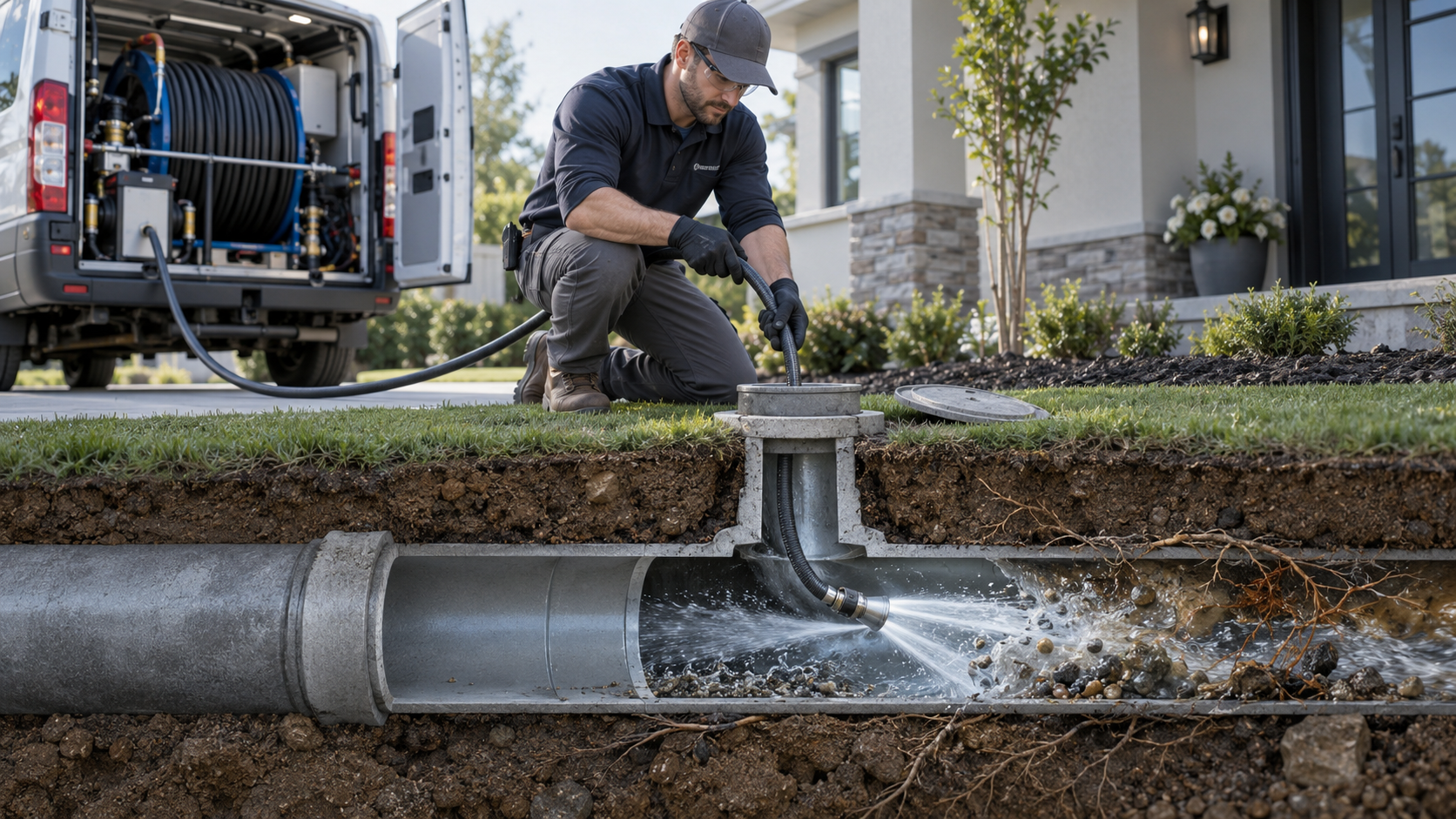
High-pressure sewer cleaning sends water through specialized equipment and nozzles designed to remove buildup from inside the pipe.
It can be useful for grease, sludge, soft deposits, and other material coating the pipe walls.
When conditions are right, this method can clean more of the interior surface than simply punching through the center of a blockage.
But there is a nuance.
Water pressure should be matched to the condition and type of pipe. A line that is already badly deteriorated deserves inspection and professional judgment before aggressive cleaning methods are used.
When Does a Sewer Camera Help?
A camera does not clean anything.
What it does is answer questions.
Why does this drain keep clogging?
Are roots coming through a joint?
Is there a cracked section?
Did the cleaning remove the obstruction?
Is there a low area where water and debris are collecting?
A camera inspection can be especially helpful when problems are repetitive, when the condition of an older sewer line is unknown, or when cleaning does not produce the expected result.
Should the Camera Inspection Happen Before or After Cleaning?
Sometimes both.
A camera may have trouble seeing much if the pipe is full of dirty water or completely blocked.
In that case, the line may need to be opened first.
After cleaning, a camera can give a clearer view of the pipe walls and reveal damage that had been hidden under debris.
If there is enough access and visibility beforehand, an initial inspection may also help determine what method makes sense.
What Is a Sewer Cleanout?
A cleanout is an access point connected to the drainage system.
It usually has a removable cap and gives a plumber a more direct route into the sewer line.
Cleanouts may be found inside basements, crawl spaces, garages, utility areas, or outside near the building. The location depends heavily on the home’s design and local construction practices.
If you know where your cleanout is, great.
If not, it is worth identifying it before the day when wastewater is coming up through the lowest drain in the house.
Can You Clean a Main Sewer Line Yourself?
Minor household drain maintenance is one thing.
Working on a main sewer line is another.
Rental drain machines can be powerful, heavy, and surprisingly difficult to control. A rotating cable can twist, bind, or move unexpectedly. Sewer water may also expose you to biological contamination.
And if the line contains roots, broken pipe, or another structural defect, simply forcing equipment farther down the pipe can create a bigger problem.
A homeowner can safely do basic observation and prevention. Major main-line cleaning is often better handled by someone familiar with the equipment and sewer layout.
Be Careful With Chemical Drain Cleaners
Pouring more chemicals into the drain can feel like the fastest solution.
For a main sewer blockage, it often is not.
A chemical product may not reach or remove a large obstruction hundreds of feet-or even dozens of feet-farther down the system. Strong chemicals can also create hazards for anyone who later opens or mechanically works on the line.
Never mix different drain-cleaning chemicals.
Different products can react with each other and create dangerous heat, fumes, or splashing.
If chemicals have already been poured into a blocked drain, tell the plumber before work begins.
What to Do During a Sewer Backup
A sewer backup changes the situation from inconvenient to urgent.
If wastewater is returning through drains, avoid unnecessary contact with it.
Stop running water through the house when practical. That means postponing laundry, showers, dishwashing, and repeated toilet flushing until the blockage is understood.
Also keep children and pets away from contaminated areas.
If water is approaching electrical outlets, appliances, extension cords, or other electrical equipment, treat the situation seriously and avoid entering water where electrical hazards may exist.
Large sewage contamination may require professional cleanup in addition to plumbing repair.
How Often Should Sewer Lines Be Cleaned?
There is no universal calendar that fits every home.
Some properties go many years without a main-line blockage.
Others need more frequent attention because of older pipes, tree roots, heavy household use, grease history, or known structural issues.
Instead of assuming that every sewer needs cleaning on the same schedule, look at the home’s history.
If the line has repeated root problems or recurring backups, preventive inspection or cleaning may make sense.
If there has never been a main-line problem and everything drains normally, routine cleaning may not need to happen nearly as often.
How to Reduce the Chance of Another Sewer Clog
You cannot prevent every plumbing failure.
You can avoid giving the sewer line extra reasons to clog.
- Keep cooking grease and oil out of drains
- Scrape food scraps into the trash or compost where appropriate
- Flush only toilet paper and human waste
- Keep wipes, paper towels, sanitary products, and cotton products out of toilets
- Use sink strainers to catch larger debris
- Watch for recurring slow drains instead of ignoring them
- Have known root problems evaluated before they cause another full blockage
- Learn where the main sewer cleanout is located
None of this is glamorous.
But neither is standing in a basement at midnight looking at water that absolutely should not be there.
Tree Roots and Sewer Lines
Tree roots deserve their own section because they are one of the most frustrating recurring sewer problems.
A healthy tree is not intentionally attacking your plumbing.
Roots simply follow favorable conditions such as moisture and available space.
If a pipe has an opening, separated joint, or damaged area, roots may enter.
Once inside, they can form a dense network that catches paper and waste.
Mechanical cutting may restore flow, but cutting roots does not repair the opening that allowed them into the line.
If roots return again and again, the condition of the sewer pipe itself should be investigated.
Does Sewer Cleaning Fix a Broken Pipe?
No.
This is one of the most important things to understand.
Cleaning removes material from inside a line.
It cannot rebuild a collapsed section, reconnect a badly separated joint, straighten a major offset, or replace missing pipe.
You may get temporary relief if debris is cleared from around a structural defect. But if the pipe itself is damaged, a repair may still be needed.
Why Older Homes May Need More Investigation
An older house can have plumbing that has been repaired, extended, modified, or partially replaced several times.
One section might be newer plastic pipe while another section is decades older.
The path may not be obvious.
If an older property’s sewer history is unclear and problems keep returning, a camera inspection can help establish what is actually underground.
Guessing becomes expensive surprisingly fast.
Buying a Home? Sewer Inspection May Be Worth Considering
Home buyers naturally look at roofs, furnaces, kitchens, foundations, and electrical panels.
The sewer line is easy to forget because most of it is underground.
Yet a damaged buried line can be disruptive and expensive to repair.
For older properties, homes with large mature trees, or homes with a history of drainage trouble, a sewer inspection can provide useful information before purchase.
It does not guarantee that the line will never have a future problem, but it can reveal visible issues that would otherwise remain hidden.
How Much Does Sewer Line Cleaning Cost?
There is no useful single national price for every job.
Costs vary by region, access, line length, type of blockage, cleaning method, emergency timing, pipe condition, and whether camera inspection or additional repairs are required.
A straightforward accessible blockage may be very different from a line filled with roots beneath a long yard.
Before approving work, ask what the quoted price includes.
Does it include the service call?
Is camera inspection separate?
Is additional cleaning charged differently?
What happens if the technician finds damaged pipe?
Clear pricing questions before work begins are much easier than arguing over an unexpected invoice afterward.
Questions to Ask Before Hiring Sewer Cleaning Service
You do not need plumbing expertise to ask useful questions.
- What do you think is causing the blockage?
- What cleaning method do you recommend and why?
- Is camera inspection included or separate?
- Will you inspect the line after cleaning if the issue is recurring?
- What happens if roots or damaged pipe are found?
- Is the total quoted price clear before work starts?
- Is there any warranty or follow-up policy for the service?
- Do you recommend further repair, or was cleaning enough?
A clear explanation matters.
You should understand whether the technician is solving a clog or diagnosing a damaged sewer system.
When Sewer Line Cleaning Is Not Enough
Cleaning should improve a blockage caused by removable material.
If the line remains slow, backs up again quickly, or repeatedly clogs in the same location, there may be more going on.
Possible issues include major root intrusion, pipe collapse, severe corrosion, a sagging section, an offset connection, or another structural defect.
At that point, repeating the same cleaning every few weeks is not much of a plan.
The pipe needs diagnosis.
Emergency Warning Signs
Some problems can wait until normal business hours.
Others deserve quicker attention.
A sewage backup affecting several fixtures, wastewater entering living space, a toilet overflowing because the main line cannot drain, or water approaching electrical equipment are situations where delaying can increase damage.
The faster water use is reduced and the cause is identified, the better.
Sewer Line Cleaning FAQ
How do I know if my main sewer line is clogged?
Common clues include several slow drains at once, toilets gurgling when other fixtures run, wastewater appearing in a low drain, or water backing into a tub when another fixture is used.
Can a plumber clean tree roots out of a sewer line?
In many cases, specialized mechanical or water-cleaning equipment can remove or reduce root blockage. If roots entered through damaged pipe, however, cleaning alone does not repair the opening.
Is high-pressure sewer cleaning better than a drain snake?
They do different jobs. Mechanical cables can break through many blockages, while controlled high-pressure water cleaning can remove certain deposits from more of the pipe wall. The right approach depends on the pipe and blockage.
How long does sewer line cleaning take?
A simple blockage may be handled during one service visit, while heavy roots, difficult access, long lines, or damaged pipes can take longer. Inspection may also add time.
Can sewer cleaning damage old pipes?
Any cleaning method should account for pipe condition. Severely deteriorated or damaged lines may need inspection before aggressive cleaning. That is one reason professional evaluation matters with older plumbing.
Why does my sewer line keep clogging?
Recurring clogs may come from roots, grease, heavy deposits, foreign material, sagging pipe, damaged joints, or another structural issue. A camera inspection can help identify repeating problems.
Should I clean my sewer line if I have no symptoms?
Not every home needs routine main-line cleaning on a fixed schedule. The decision depends on the property’s plumbing history, pipe condition, root problems, previous backups, and other risk factors.
Conclusion
Sewer line cleaning is one of those home-maintenance topics nobody thinks about until the drains start making suspicious noises.
And by then, timing matters.
A single slow sink is often a small local issue. Several slow fixtures, gurgling toilets, wastewater appearing in lower drains, or repeated backups point toward something farther downstream.
The first goal is restoring safe flow.
The second is understanding why the blockage happened.
That second part gets missed surprisingly often.
Grease and debris can be cleaned. Roots can often be cut or cleared. Heavy deposits can sometimes be removed from pipe walls. But cleaning cannot fix a collapsed, cracked, separated, or badly sagging sewer line.
If a blockage keeps returning, a camera inspection can help separate “the line is dirty” from “the line itself has a problem.”
That difference matters.
Otherwise, homeowners can end up paying to clear the same pipe again and again while the real cause sits underground unchanged.
Basic prevention still helps.
Keep grease out of sinks. Do not treat the toilet like a trash can. Be skeptical of anything marketed as flushable if it does not break down like toilet paper. Watch for patterns when several drains begin behaving differently.
And learn where your sewer cleanout is.
It is not exciting information, but it becomes very exciting when the basement floor drain starts bubbling on a Sunday night.
If sewage is actively backing up, reduce water use and keep people and pets away from contaminated areas. Do not keep flushing toilets or running appliances to “see if it clears.” That only sends more water toward the blockage.
For professional sewer line cleaning, ask what method is being recommended and why. Ask whether the line should be inspected afterward. Ask what happens if roots or damaged pipe are discovered.
You do not need to understand every plumbing tool.
You do need to know whether the job is simply clearing debris or dealing with a larger sewer problem.
When everything is working again, pay attention to how the drains behave.
They should not need constant persuasion.
A healthy drainage system is pretty boring, actually.
Water goes down. Toilets flush. Nothing bubbles back up.
And when it stays that boring, everybody wins.
Leave a Reply