
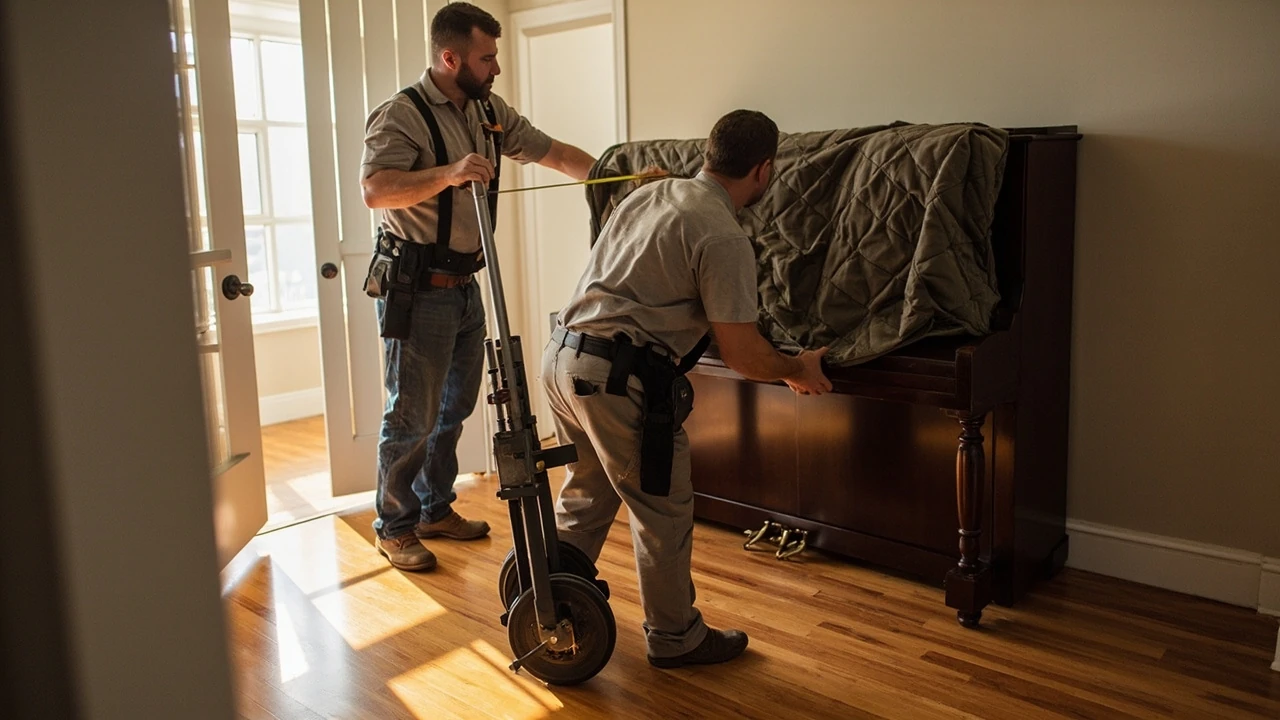
Piano moving: what actually makes it different from a regular furniture move
A piano is not a heavy box and not a piece of furniture. It is a tuned instrument built from thousands of wooden, felt, and metal parts that were never designed to be tilted, dragged, or carried down a flight of stairs. The first 60 seconds of a typical move usually decide whether a piano arrives in tune and in one piece, or arrives with cracked soundboard glue joints, scarred lacquer, and a tuning pin that will not hold pitch. That is why piano moving is treated as its own trade, separate from general household moving, even though it looks similar on a work order.
This guide focuses on what homeowners, buyers, sellers, church staff, and school administrators actually need to know before scheduling a piano move. It covers the different types of pianos and how they are handled, what access problems change the price and the plan, the real risks of a do-it-yourself move, and the practical decisions that decide whether to hire a specialty crew, a general mover with piano experience, or attempt the job yourself with rented equipment.
Why pianos are moved differently from other heavy items
General movers are trained to load trucks efficiently, protect furniture from scratches, and minimize labor on the home end. Piano movers are trained to keep a very specific, very heavy object stable while it travels through spaces that were not designed for it. The difference shows up in three places: how the instrument is prepped, how the path is measured, and what equipment is brought to the job.
Acoustic pianos weigh between roughly 300 and 1,200 pounds depending on style, and that weight is concentrated low and at the back. They are top-heavy in some configurations and back-heavy in others, which means a careless tilt can shift the center of gravity faster than an untrained mover can react. Their finishes range from high-gloss polyester to thin French polish, all of which mark easily under straps, dolly edges, and door trim. Inside, the soundboard, ribs, bridges, and pinblock are joined with hide glue and case glue that are sensitive to shock and humidity swings.
None of this means a piano cannot be moved. It means the move has to be planned around the instrument rather than around the truck.
Piano types and how each one is handled
Every piano moving estimate starts with the same question: what kind of piano is it? The instrument type drives the crew size, the equipment, and whether any disassembly is needed before the piano leaves the room.
| Piano type | Typical weight | Common locations | Handling notes |
|---|---|---|---|
| Spinet | 300–500 lb | Older homes, starter uprights | Compact vertical; legs usually stay on; tight hallways can still cause problems |
| Console | 400–600 lb | Living rooms, family rooms | Slightly taller than a spinet; still moved fully assembled in most cases |
| Studio upright | 500–700 lb | Schools, rehearsal spaces, apartments | Taller cabinet; check ceiling clearance on stairs and through doorways |
| Full upright | 600–900 lb | Houses, churches, older institutions | Dense and tall; almost always moved on a piano board with four movers |
| Baby grand | 500–700 lb | Living rooms, small performance spaces | Legs and lyre usually removed; lid may be removed or padded in place |
| Standard grand (5’7″–7′) | 700–1,000 lb | Concert venues, teaching studios | Legs, lyre, and sometimes music desk removed; full padding and skid board required |
| Concert grand (7’–9’+) | 900–1,200+ lb | Concert halls, conservatories | Disassembly is standard; job usually requires a pre-move walkthrough with measurements |
| Console digital (weighted keys) | 100–400 lb | Home studios, churches | Not acoustic, but heavy; cabinets and pedal systems may still need partial disassembly |
The practical takeaway is that two uprights of similar size can weigh very differently, and two grands of similar length can require very different prep work. Telling a mover “it’s just an upright” or “it’s a baby grand” is a useful start, but it is not enough to plan the job.
Access is the real planning problem
Most piano moving problems are not about the piano. They are about the building. A crew that can easily handle a 700-pound upright still has to get the instrument out of a 32-inch doorway, around a 90-degree turn at the bottom of a hallway, down three porch steps, across a gravel driveway, and up two steps at the destination. Every one of those points is a place where something can go wrong.
Professional piano movers treat the access walkthrough as part of the job, not as a formality. A useful pre-move check covers the following points:
- Type, make, and model of the piano when known, plus an estimate of the year if the owner has records.
- Width, height, and depth of the piano itself, measured at the widest points including the bench.
- Width of every doorway, measured between the trim, with the door fully open and the swing direction noted.
- Length, width, and turning radius of every hallway, foyer, or stair landing on the route.
- Number of steps at every level change, both inside and outside the building.
- Floor surfaces: hardwood, tile, low-pile carpet, loose rug, or exterior concrete.
- Threshold height at exterior doors and any porch or stoop that the piano has to cross.
- Distance from the exit to the truck, and the surface of that path.
- Whether a ramp is available, and how steep it is.
- Driveway length, slope, and whether the truck can park close to the door or has to stay at the street.
When those details are not gathered, the crew shows up on moving day and finds out that the piano fits through the door but cannot make the turn, or that the gravel slope is too soft for a loaded dolly, or that there are six steps at the back door instead of three. Each surprise is an extra charge, an extra hour, or a damaged instrument.
How professional piano movers actually move a piano
The exact sequence varies with the instrument and the access, but a standard upright move follows a pattern that has been refined over decades. Knowing the sequence helps a homeowner understand what they are paying for and where the real risk is.
On-site preparation
Before any equipment is brought in, the room is prepared. Anything on top of the piano comes off: sheet music, lamps, framed photos, metronomes, vases. Decor on nearby walls and shelves is taken down if it sits in the path. Rugs are rolled back, and the route is checked again with a tape measure rather than by eye.
Piano prep
The piano itself is protected first. Heavy moving blankets are wrapped around the cabinet and taped or strapped so they do not shift. Corners and edges, which are the most likely to be damaged, get extra padding. The keyboard lid is closed and usually locked or strapped. Bench and any matching furniture are wrapped separately.
Loading the piano
For uprights, the piano is tipped gently back onto a piano board, a heavy plywood surface with skids that distributes the weight and lets the crew roll it on a four-wheel dolly without putting stress on the legs or casters. The board is strapped to the piano so it cannot slide. For grands, the legs, lyre, and sometimes the lid are removed first and packed individually, and the body is laid on a padded skid board that is built to the piano’s dimensions.
Path and truck
The piano on its board is rolled along the route that was measured earlier. At each level change, the team stops, repositions the dolly, and lifts the load together on a verbal count so that weight transfers are even. Outside, the path to the truck is checked one more time, and a ramp is used to bridge the truck liftgate or the truck floor when needed.
Truck setup
Inside the truck, the piano is secured so it cannot roll or shift in transit. Straps anchor it to the wall, and blocking is placed around the base. Grands are usually transported on their custom skid, with the legs, lyre, and lid locked in separate compartments and padded to prevent vibration damage.
Delivery
At the destination, the process runs in reverse, with one important addition: the final placement of the piano is decided before the crew unloads. A piano that is unloaded into a room and then nudged three feet to the left costs an extra move. The destination room should already be cleared, the path inside the home prepared, and the exact final spot marked on the floor.
What can go wrong on a piano move
Damage from a piano moving job falls into a small number of predictable categories, and most of them are preventable with the right planning.
- Case damage: scratches, gouges, and crushed corners from contact with door trim, railings, or dolly edges. The most common cause is skipping the padding or rushing a tight turn.
- Leg and caster damage: broken legs on uprights and grands happen when the piano is dragged sideways or tipped without a board. Replacement legs can be expensive on older or discontinued models.
- Internal mechanical damage: jolts can knock hammer parts out of alignment, bend or break strings, and crack the soundboard. The damage may not be visible until a technician inspects the action.
- Tuning instability: even a smooth move will usually change the pitch. A new environment with different humidity is a bigger factor than the trip itself, but a rough move amplifies the effect.
- Property damage: torn carpet, scuffed hardwood, and dented door frames from forcing a too-large instrument through a too-small opening.
- Injury: crushed hands and feet, back injuries, and falls are the most common serious injuries. Pianos are heavy enough that a dropped piano on a foot is a medical event, not an inconvenience.
Each of these risks is small in isolation and serious in combination. A homeowner who has never moved a piano tends to underestimate the weight, the awkwardness, and the number of times the load has to shift hands.
DIY piano moving: when it is reasonable and when it is not
There are situations where a do-it-yourself move is genuinely reasonable, and there are situations where it is a bad idea regardless of how strong the helpers are. The distinction comes down to instrument type, access, and the value of the piano.
| Factor | DIY may be reasonable | DIY is risky |
|---|---|---|
| Piano type | Console digital, small spinet, lightweight upright with no steps | Full upright, any grand, anything with a lyre or music desk |
| Access | Ground floor to ground floor, no stairs, wide straight path | Stairs, tight turns, narrow doors, gravel, slopes, second story |
| Three or more adults with moving experience and a real piano dolly | Two friends, no equipment, no experience | |
| Value of the instrument | Entry-level or digital, low replacement cost | Mid-range or better acoustic, inherited, or expensive to retune and repair |
For a digital console on a single ground floor, with a straight path and three or four capable helpers, a careful DIY move with rented blankets and a heavy-duty appliance dolly can be a reasonable option. For anything else, the cost of a professional move is usually a small fraction of the cost of a single repair to the action or case, and the risk of injury is much higher without a crew that has done it before.
How piano moving is priced
Pricing varies by region and by the specifics of the job, but the structure is consistent. The main drivers are instrument type, total distance, and access difficulty. A simple local move of a console upright between two ground-floor rooms is at the low end. A long-distance move of a concert grand down a narrow stairway at the destination is at the high end. The components a customer is usually quoted on include:
- Base move fee: covers the crew, the truck, and standard equipment for the instrument type.
- Distance and travel time: usually calculated by the mile or by zone for local moves, and by weight and mileage for long-distance.
- Stair fees: charged per flight, with a cap that depends on the mover’s own safety policy.
- Long carry or shuttle fees: apply when the truck cannot park near the building and the piano has to be moved further by hand.
- Disassembly and reassembly: required for most grands and some digital consoles, priced by the piece.
- Piano boxing: for long-distance transport, where a wooden crate is built around the instrument for shipping.
- Tuning and technical service: handled separately by a piano technician, usually scheduled a week or two after the move.
For a sense of scale, a local move of a single upright with ground-level access and no stairs in a small city is often in the low hundreds of dollars, while a long-distance move of a grand with stairs at one end is commonly in the low thousands. Specialty concert grands and hoisting jobs are quoted individually after a site visit.
Choosing the right piano mover
Not every mover who says they move pianos actually specializes in them. The distinction matters because general household movers and piano movers are solving different problems. A household mover is optimizing a truck; a piano mover is protecting an instrument. When comparing quotes, it is worth asking a few direct questions.
- How many piano moves the crew completes in a typical month, and what the largest instrument they handle is.
- Whether the company carries insurance that specifically covers the piano, not just generic household goods.
- What happens if the piano is damaged in transit and how claims have been resolved in the past.
- Whether they perform the move with their own trained employees or subcontract it to a day-of crew.
- What their policy is on stairs, hoisting, and access problems, and whether there is a hard cap that would require them to refuse the job rather than improvise.
A mover that answers these questions clearly and provides a written estimate after a real walkthrough or detailed video is generally a safer choice than one that gives a flat price over the phone for a complex job. The detailed walkthrough itself is a good early signal: crews that take the time to measure the path tend to be the crews that take the time to protect the piano.
Preparing your home for a piano move
Home preparation is one of the few parts of piano moving that the owner controls directly, and it is the part that most often gets skipped. The crew cannot move a grandfather clock that is sitting in the hallway, and they cannot protect a wall that has a glass-framed print hanging at shoulder height. A short prep checklist, run the day before the move, makes the actual job faster and safer.
- Clear every room on the piano’s path of small furniture, plants, area rugs, and wall decor.
- Remove doors from their hinges at every tight opening and store them out of the way.
- Identify the exact final location for the piano at the destination and mark the floor with tape.
- Make sure the destination room is climate-stable, away from direct sunlight, heating vents, and exterior doors.
- Set aside a safe spot for any bench, lamps, and accessories that travel with the piano.
- Have payment ready, confirm the arrival window the night before, and keep the phone on for last-minute changes.
Homeowners who handle this list tend to have shorter, cheaper moves with fewer surprises. Crews that arrive to a clear path and a marked destination can finish in less time, which is what most piano moving companies price against.
Tuning, acclimation, and what to expect after the move
A piano’s tuning is sensitive to the environment it lives in, not just to the trip itself. After a move, two things are happening at once: the instrument is settling into a new room, and the strings, soundboard, and pinblock are adjusting to new temperature and humidity. Tuning too soon, before the piano has had a chance to acclimate, usually means the tuning will not hold.
A practical guideline used by most technicians is to wait at least a week, and often two to three weeks, before scheduling a post-move tuning. During that time, the piano should be kept in a stable part of the home: away from heating and cooling vents, away from direct sunlight through south-facing windows, and away from exterior doors that open frequently. A basic hygrometer in the room is a useful tool, since very dry or very humid conditions slow acclimation and can cause additional movement in the wood.
It is also worth remembering that the move is not the only reason a piano goes out of tune. If the instrument was already due for service, the move is a natural moment to bring in a technician for a full evaluation, not just a tuning. Regulation, voicing, and action work are separate services that are often deferred but become more practical when a technician is already on site.
Special situations: churches, schools, and concert venues
Institutional piano moves add a layer of complexity that residential moves do not have. Concert grands may have to cross a stage with limited truck access, schools often move instruments between buildings or to storage, and churches frequently inherit older pianos that have not been moved in decades. In these cases, the planning checklist expands:
- Coordinate with facility management for elevator reservations, dock access, and security clearances.
- Schedule the move outside of performance, class, and service times, with a buffer in case the job runs long.
- Plan for the piano to be off-stage or out of the sanctuary for a known window, since tuning and setup will follow.
- Document the piano’s condition with photographs before and after the move for the institution’s records.
- Verify that the institution’s insurance, or the mover’s, covers instruments of the value being moved.
For a concert grand on a stage, the route is almost always measured in person rather than by video, because stage dimensions, backstage corridors, and loading dock heights have to be verified to the inch. A site visit by the mover ahead of time is standard practice for this kind of job.
Long-distance piano moving
When a piano is moving more than a few hundred miles, the job changes shape. Long-distance piano moves are usually priced by weight, mileage, and instrument type, and the piano is typically crated for the trip. The crate is built around the instrument with internal padding that holds it in place against vibration and shock, and the crate itself is strapped inside the truck.
Three points are worth keeping in mind for long-distance work:
- Schedule the tuning at the destination, not before departure, so the piano is tuned in its new environment.
- Ask the mover whether the move is on a dedicated piano truck or shared with household goods, since handling and timing are different.
- Confirm the insurance coverage in writing, with the declared value of the instrument included in the estimate.
For cross-country moves, many homeowners use a specialty piano shipper rather than a general household carrier, because the equipment, the crew training, and the claims process are all built around the instrument rather than the household.
How bluehammerbuild.com approaches homeowner projects like this
Although the site focuses mostly on home improvement, contracting, and homeowner-side decisions, the same planning mindset applies to a piano moving project: measure first, get a written scope, confirm the access, and protect what is valuable before the crew arrives. The same approach shows up in homeowner guides on the site such as the practical walkthrough of garage door cable replacement, where the work is mechanical, heavy, and easy to get wrong with a guess, and the planning-focused piece on hiring home remodeling contractors, which deals with the same kind of detailed access and scope questions that come up on moving day.
A short checklist before you book
Before calling for a quote, the following information lets a piano mover give a real number rather than a placeholder:
- Piano type, make, model, and age if known.
- Pickup address, with floor level and number of steps at the exit.
- Destination address, with the same details.
- Any tight turns, narrow hallways, or unusual access at either end.
- Whether the piano needs to be moved as part of a larger household or commercial move, or as a stand-alone job.
- Preferred date and a backup date, in case the schedule is tight.
With that information, a quote becomes a real quote, the work order becomes a real work order, and moving day becomes the routine job it should be, instead of the surprise it often turns into.
Frequently asked questions
How much does piano moving usually cost?
For a local move of an upright with ground-level access, the price is commonly in the low hundreds of dollars. Long-distance moves, grands, and any job with stairs or difficult access can run into the low thousands. The most reliable way to get a real number is a written estimate after the mover has confirmed the instrument type and the access at both ends.
Can a regular moving company move a piano?
Some general movers do handle uprights and small grands as part of larger household jobs. The question to ask is how often the actual crew that shows up has moved a piano, and whether the company carries specific insurance for instruments. For larger or more valuable pianos, a specialty piano mover is usually the safer choice.
How long does a piano move take?
A straightforward local move of an upright with ground-level access at both ends usually takes 1.5 to 3 hours including setup and placement. Moves with stairs, long carries, or disassembly of a grand can take a full half day or longer, and the estimate should reflect that.
Do I need to tune the piano after the move?
Yes. Tuning after a move is standard, and most technicians recommend waiting at least a week for the instrument to acclimate to its new environment. The move itself is not the only reason the tuning changes; a different room with different humidity and temperature is often a larger factor.
Is it safe to move a piano myself?
For a small console or digital piano on a single ground floor with a straight path, a careful DIY move with proper equipment and enough helpers can be reasonable. For full uprights, any grand, and anything with stairs, the risk of damage to the instrument and injury to the helpers is high enough that a professional move is the better choice.
How do I prepare the house before the crew arrives?
Clear the path on both ends of the move. Remove rugs, wall decor, and small furniture. Take doors off hinges at tight openings. Decide exactly where the piano will go at the destination and mark the floor. Make sure the destination room is climate-stable and away from direct sunlight and heating vents.
What information does a piano mover need for an accurate quote?
Instrument type, make, and model if known, plus the pickup and destination addresses, the floor level, the number of steps at every level change, the width of doorways, and a note on any tight turns or unusual access. Photos or a short video of the piano and the route help significantly when an in-person walkthrough is not practical.
Can a piano be moved in freezing or very hot weather?
Acoustic pianos are sensitive to temperature extremes, and a long trip in a hot or cold truck can cause cracking in the soundboard and finish. Most movers will schedule around forecast extremes or use a climate-controlled truck. Short moves between climate-controlled spaces are generally fine in any weather.
Do movers handle the bench and accessories too?
Yes, matching benches are usually wrapped and moved with the piano. Sheet music, lamps, and decorative items should be removed by the owner before the crew arrives, since loose items on top of the piano are the first things to fall during a tilt.
What happens if the piano is damaged during the move?
Reputable movers carry insurance that specifically covers the instrument, and a damage claim is filed with documentation of the condition before and after. The pre-move walkthrough or video is the owner’s protection here, which is why documenting the piano’s condition ahead of time is worth the few minutes it takes.
Leave a Reply