
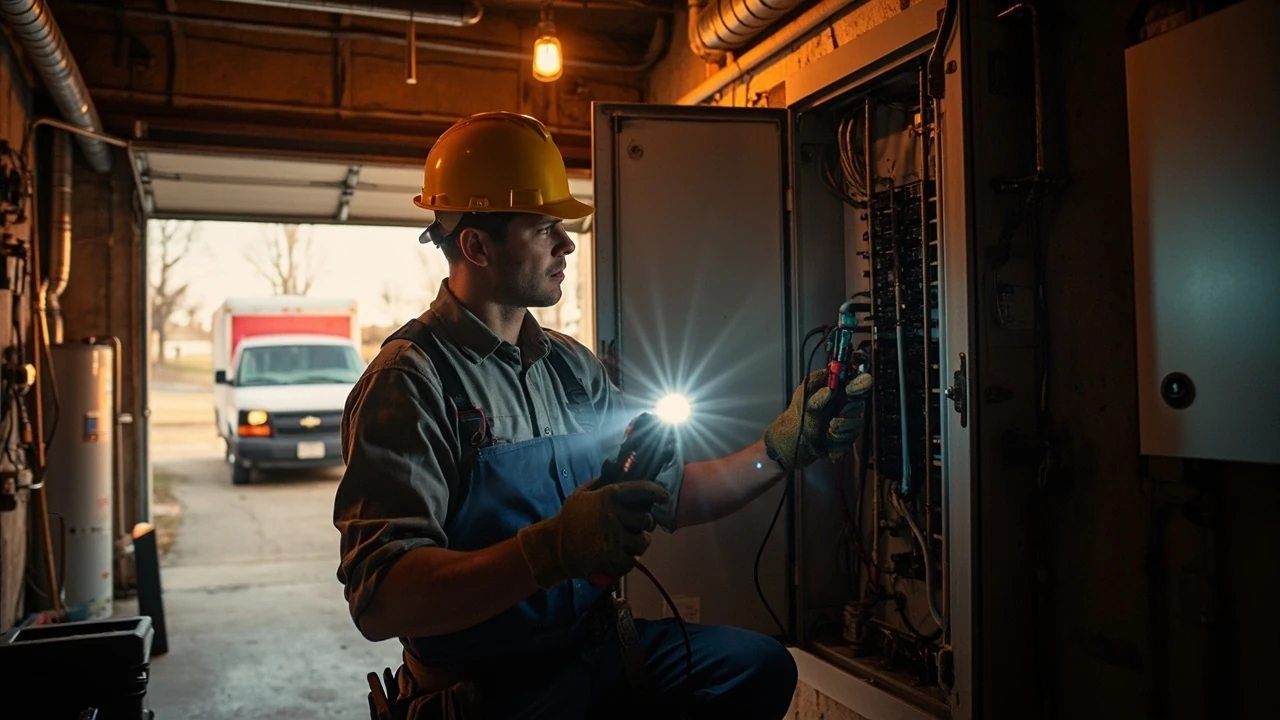
Emergency electrical service: when a home problem cannot wait
A burning smell near the breaker panel, a partial blackout that leaves the refrigerator silent at 10 p.m., a smoking outlet in a child’s bedroom, or a storm that has pulled the service mast away from the house. These are the situations that make a property owner pick up the phone and ask for an emergency electrical service instead of waiting three days for a routine appointment. The phrase is used loosely, but in practice it describes a small set of failures that combine three traits: a real safety risk, the potential for damage to the home if nothing is done, and a need for someone with the right tools and authority to make the system safe on the spot.
This article walks through what emergency electrical service actually covers, the warning signs that justify the call, what a homeowner should and should not do before the technician arrives, how pricing and response windows are typically structured, and how to choose a qualified provider in advance rather than in the middle of a crisis. It is written for a general residential audience in the United States, not for commercial facilities, and it leans on the language used by licensed electricians, building departments, and electrical inspectors rather than on manufacturer marketing.
What counts as an emergency electrical service call
Most licensed electricians distinguish between a true emergency, an urgent call, and a routine service visit. The distinctions matter because they drive how fast someone shows up, what tools they bring, and what they will charge.
| Category | Typical examples | What a technician does | Typical response window |
|---|---|---|---|
| True emergency | Active fire or smoke from a panel, arcing wires, electrical shock involving a person, flood near live equipment, partial loss of power to a home with medical devices | Disconnects power, makes the scene safe, documents hazards, arranges follow-up repair or inspection | One to four hours, often with a 24/7 dispatch line |
| Urgent but not on fire | Loss of half the circuits, a breaker that will not reset, a sparking outlet that has stopped, water in a light fixture after a leak | Diagnoses the fault, isolates the affected circuit, may install a temporary repair, schedules a permanent fix | Same day, often within a few hours during business hours |
| Routine | Replacing a dead outlet, swapping a tripping GFCI, installing a ceiling fan, adding a dedicated appliance circuit | Plans the work, may need a permit, schedules a normal appointment | One to several days out, by appointment |
The same electrician may handle all three categories, but the dispatch, the van, and the on-call rate are different. A homeowner who can describe the problem clearly using the language in the table above usually gets triaged faster, because the dispatcher can put the right person on the road with the right parts.
Warning signs that justify an emergency call
Electrical failures tend to escalate quietly. A connection that runs hot for months may not trip a breaker, and a breaker that has been tripping occasionally may be masking a deeper problem. The signs below are the ones that licensed electricians consistently treat as triggers for a same-day or after-hours visit rather than a scheduled appointment.
- Smoke, a burning smell, or visible charring on an outlet, switch, or breaker, even if the device still appears to work.
- Buzzing, sizzling, or popping sounds coming from inside a wall, a panel, or a junction box.
- Flickering or dimming lights that are isolated to one area, especially when a large appliance cycles on, combined with a warm wall plate.
- A breaker that trips immediately after being reset, or a breaker that will not stay in the on position.
- Partial loss of power in the home where some rooms work and others do not, particularly if the neighbor’s power is fine.
- Any shock, even a mild tingle, from an appliance, a faucet, a light switch, or a pool or spa component.
- Water inside a light fixture, an outlet, a panel, or any low point in the electrical system after a leak or flood.
- Visible damage to a service mast, meter base, or the cable running from the utility drop to the house after a storm or impact.
Any one of these by itself is enough to call. Two of them together, such as a warm outlet combined with a faint smell, usually points to a loose or arcing connection that has been developing for a while and is now in the late stage before failure.
What an emergency electrical service technician actually does
Most emergency calls follow a predictable workflow. Understanding it helps a homeowner know what to expect, what questions to ask, and what is reasonable to push back on.
Step 1: Triage by phone
The first conversation is about safety. A good dispatcher will ask whether anyone is hurt, whether there is active smoke or fire, whether water is present, and whether any household member relies on electrically powered medical equipment. Based on the answers, the technician arrives with the appropriate protective equipment, test instruments, and common replacement parts.
Step 2: Make the scene safe on arrival
The first physical action is usually to remove the immediate hazard rather than start a full repair. That can mean opening the main breaker, locking out a specific circuit, or, in the case of a damaged service entrance, coordinating with the utility to drop power to the home. The technician’s job in this phase is to stop further damage and protect people, not to restore every convenience.
Step 3: Diagnose the cause
With the system in a safe state, the technician uses a multimeter, a clamp meter, or, in more complex cases, a circuit tracer or insulation resistance tester to find the actual fault. Common findings include a failed breaker, a backstab connection that has loosened, a splice that has overheated, a damaged cable in a wall, a flooded junction box, or a failing service neutral.
Step 4: Repair, replace, or stabilize
If the parts are on the truck and the situation allows it, the technician performs a permanent repair. If the problem requires parts that are not on the truck, such as a specialty breaker, a long cable run, or a new meter base, the technician usually performs a code-compliant temporary repair that restores safe function and schedules a return visit. A home left without partial power for a few days is a normal outcome of this step.
Step 5: Document and recommend
A reliable emergency service provider leaves the homeowner with a written description of what was found, what was done, and what should be done next, often with photos. This is useful for insurance claims, for the building department, and for the next electrician who walks through the door.
What the homeowner should and should not do while waiting
There is a short, sensible list of actions a homeowner can take in the first few minutes of an electrical problem. There is a longer list of actions that look reasonable but usually make things worse.
| Reasonable to do | Avoid doing |
|---|---|
| Turn off the breaker that feeds the affected outlet, switch, or appliance, if it is clearly labeled. | Open the panel cover and pull a breaker out by the base, or try to reset a breaker repeatedly. |
| Open windows for ventilation if there is a faint burning smell, then leave the area. | Use a fan, vacuum, or air freshener to mask a persistent burning smell. |
| Unplug appliances on a circuit that is acting up, and stop using that circuit. | Continue using a flickering outlet or a warm switch, even if it seems to be working. |
| Use a flashlight, not candles, for lighting if there is any chance the problem involves the wiring. | Place a flashlight, phone, or radio on a wet surface that may also be electrically energized. |
| Move a person who has been shocked away from the source using a dry, non-conductive object if it is safe to do so, and call emergency medical services if there is any symptom. | Touch the person or the source of a shock with bare hands, especially while standing on a wet surface. |
| Keep the path to the panel clear for the technician. | Stack boxes or clothing in front of the breaker panel. |
If the situation is already past the point of being controlled by a breaker, the correct response is to leave the home, call 911 if there is fire or smoke, and then call for an emergency electrical service. The technician can take it from there.
How emergency electrical service pricing typically works
Emergency rates are higher than scheduled rates for a reason: the electrician is paying for on-call staff, a stocked van, and the willingness to interrupt a planned day. Pricing structures vary by region and company, but most fall into one of three patterns.
- Flat dispatch fee plus hourly labor. The dispatch fee covers the trip and the first portion of the diagnostic time, and labor is billed after that. This is the most common structure for established residential companies.
- Minimum trip charge plus time and materials. Common for one-person operators and smaller shops. The minimum often covers the first hour, and parts are billed at retail plus a markup.
- Tiered after-hours premium. A base rate during business hours, a higher rate in the evening and on weekends, and the highest rate overnight and on holidays. The premium is often a multiplier on labor rather than on parts.
A few things are worth knowing before agreeing to a number. Most reputable companies will quote a dispatch or minimum charge up front, give a clear hourly rate, and explain that the final total depends on what is found. A company that refuses to discuss rates before rolling a truck, or that quotes a flat price for a problem that has not been diagnosed, is a flag to slow down and ask more questions.
Homeowner’s insurance does not usually cover the cost of an emergency visit itself, but the damage that prompted the visit, such as a lightning strike, a fallen tree, or a pipe that burst into a panel, may be covered under a separate portion of the policy. Photographic documentation and a written invoice help if a claim becomes necessary.
How to choose a provider before the emergency happens
The worst time to vet an electrician is at 9 p.m. with a smoking outlet in the next room. For additional context, Homeowners who do a small amount of homework in advance are in a stronger position when a real emergency hits.
- Check state and local licensing. In most U.S. jurisdictions, electrical work requires a license at the company level and often at the individual level. The state contractor board or local building department can confirm that a license is current and in good standing.
- Confirm insurance. General liability and workers’ compensation coverage protect the homeowner if a technician is injured on site or if the work causes damage. A certificate of insurance should be available on request.
- Look for real, recent local reviews. The pattern of reviews over time matters more than any single review. A company with a consistent record of on-time, well-documented emergency work is a safer choice than one with a few five-star reviews and a long string of complaints.
- Ask about the on-call setup. Some companies use a shared answering service. Others rotate a real employee through the on-call slot. The second model usually means better triage and more accurate arrival windows.
- Walk through the home’s electrical basics ahead of time. Knowing where the main breaker is, how to shut off a water heater, and which circuits feed which rooms turns a stressful call into a manageable one.
It also helps to understand the broader context. A licensed electrician is part of a wider set of home remodeling contractors and trades who work on a house. Knowing the company’s other specialties can be useful later, especially if the emergency reveals a deeper issue such as an undersized service panel, aluminum branch wiring, or an ungrounded older system that a renovation plan should address.
The role of permits, codes, and inspections in emergency work
A common point of confusion is whether an emergency repair needs a permit. The general answer is that any electrical work beyond a like-for-like swap of a device usually does, but that an emergency can be stabilized first and permitted later. The exact line depends on the local building department, and a licensed electrician will know where it is drawn in the homeowner’s jurisdiction.
The relevant code in most of the United States is the National Electrical Code, often adopted with local amendments, along with the rules of the local authority having jurisdiction. Work that crosses into the service entrance, the meter, or the utility’s side of the system typically needs the utility to be involved and may require a separate inspection before power is restored.
Homeowners should not be surprised if an emergency visit ends with a recommendation for a follow-up permit and inspection. That is a sign that the technician is working within the local regulatory framework, not an upsell.
Special situations: storm, flood, fire, and medical equipment
Four situations come up often enough that they are worth describing on their own.
Storm and lightning damage
Wind, falling trees, and lightning strikes are common causes of sudden electrical problems. The service mast, the meter base, and the line from the utility drop to the house are particularly exposed. After a storm, the priority is to keep people away from downed lines, check the inside of the home for the smell of smoke or the sound of arcing, and call for an emergency electrical service. The utility will need to be involved if the damage crosses into the service drop.
Flood and water intrusion
Water and energized equipment are a serious combination. Any panel, outlet, or wiring that has been submerged should be treated as compromised until inspected and tested. The standard response is to keep power off to the affected area, have an electrician test the insulation, and replace any device or section of cable that fails the test. Cleaning and drying come first; re-energizing comes after the electrical system has been checked.
Fire or smoke
If a fire has already started, the first call is 911. Once the fire is out and the home is cleared, an emergency electrical service technician works with the fire department’s report and, often, the insurance adjuster to determine what can be restored and what must be replaced. Panels, breakers, and branch wiring that have been exposed to heat are usually replaced rather than reused.
Medical equipment at home
A household that depends on a ventilator, a dialysis machine, a stair lift, or similar equipment should plan ahead with both a licensed electrician and the equipment supplier. A common preparation is the installation of a transfer switch and a portable generator inlet, so that a generator can power the essential circuits during a long outage. The generator itself, the fuel storage, and the ventilation of the running engine are their own safety topics and should be discussed with a qualified installer rather than improvised during a power failure.
What to ask during the call and after the visit
Most homeowners do not think of the right questions until the truck is already pulling away. A short list, written down and kept near the panel, makes the conversation more productive.
- What exactly did you find, and what is the most likely cause?
- What did you do to make the system safe, and what, if anything, is still a hazard?
- Is the current state code-compliant, or is this a temporary fix that needs follow-up?
- What parts were replaced, and do they carry a warranty?
- What should I avoid doing until the follow-up work is done?
- If a permit or inspection is required, who handles that and on what timeline?
- Can I get the visit written up with photos for my records and, if needed, my insurance company?
The answers to those questions give a homeowner a clear picture of the situation and a paper trail if anything needs to be revisited.
How emergency work connects to a longer-term plan
An emergency visit is sometimes the first time a homeowner sees the inside of their own panel in years. What the technician finds can be the starting point for a longer plan.
Older homes with fuse boxes, limited circuit capacity, two-wire ungrounded branches, or a mix of older aluminum and newer copper wiring are common candidates for a service upgrade or a partial rewire. A house that has added a hot tub, a level-2 car charger, or a finished basement over the years may have a panel that is simply full, which is a separate problem with its own solution. A licensed electrician who has done the emergency work is in a good position to outline the options and to separate must-do safety work from optional improvements.
For homeowners who are weighing that kind of broader work alongside other projects, a practical overview of how to hire the right home remodeling team in 2026 is a useful reference. Electrical upgrades are often coordinated with plumbing, HVAC, and finish work, and the sequencing matters.
Common misconceptions about emergency electrical service
A few ideas show up often enough in online forums to be worth correcting clearly.
- “If the breaker isn’t tripped, the problem can’t be electrical.” Breakers protect wiring from overcurrent, not from every kind of failure. Loose connections, damaged insulation, and arcing can all happen inside a breaker that never trips.
- “If the lights work, the wiring is fine.” A circuit can still power a lamp while a receptacle on the same circuit has a failing splice hidden in the wall.
- “An electrician can do this in five minutes, so the bill should be small.” Most of the cost of an emergency visit is the trip, the diagnostic time, the parts on the truck, and the willingness to come out at odd hours, not the minutes of hands-on work.
- “If the power company is responding, the electrician isn’t needed.” The utility owns the line up to the meter. Everything from the meter into the house is the homeowner’s responsibility, and an electrician is the right trade for that side of the system.
- “Anyone can reset a tripped breaker.” Resetting a breaker that trips immediately is a warning sign, not a fix. The cause still needs to be diagnosed.
A short pre-emergency checklist for the home
Most homes would benefit from a 20-minute walk-through once a year, not in response to a problem, but as preparation for one.
- Locate the main breaker and the meter, and confirm the path to both is clear.
- Label the breakers. A labeled panel turns a stressful call into a faster one.
- Identify the circuits that feed the kitchen, the bathroom, the laundry, the HVAC, the water heater, and any medical or work-from-home equipment.
- Test GFCI and AFCI devices using their built-in buttons, and replace any that will not reset.
- Walk the home looking for warm outlets, discolored wall plates, and the smell of something that should not be there.
- Pick a licensed emergency electrical service provider before one is needed, and keep the number where it can be found in the dark.
None of those steps prevents every failure, but together they shorten the response time and the cost of the ones that do happen.
Frequently asked questions
What is the difference between emergency electrical service and a normal service call?
An emergency electrical service is dispatched for situations that present an immediate safety risk, an active hazard, or a loss of essential function outside of business hours. A normal service call is scheduled in advance, during regular business hours, and is appropriate for non-urgent work such as adding an outlet, replacing a fixture, or troubleshooting a long-standing nuisance trip.
How fast can an emergency electrician actually get here?
Response windows depend on the region, the time of day, and the company’s staffing. In a dense urban area with a 24/7 on-call rotation, a one to three hour arrival is common. In a rural area, four to six hours is more typical, especially overnight. The dispatcher should give a realistic window rather than a vague promise.
Can the power company handle this instead?
The power company owns and maintains the line up to the meter, and it should be the first call if the problem is clearly on the utility side, such as a downed line or a damaged transformer. Problems from the meter into the home, including the main panel, the interior wiring, and the appliances, are the homeowner’s responsibility and require a licensed electrician.
Is an emergency repair the same as a permanent fix?
Not always. Emergency work is focused on making the system safe and restoring essential function. A permanent repair is sometimes completed during the same visit, but in other cases the technician installs a code-compliant temporary solution and schedules a return visit with the correct parts or after a permit has been pulled. The invoice and the technician’s notes should make the distinction clear.
Will an emergency visit be covered by homeowner’s insurance?
Most policies do not cover the service call itself, but they may cover the underlying damage that caused the emergency, such as a lightning strike, a fallen tree, or a sudden pipe failure. The repair and the documentation, including dated photos and a written invoice, are usually what the adjuster needs.
Do electricians need to be licensed for emergency work?
In most U.S. jurisdictions, yes. Electrical work, including emergency diagnostics and repairs, requires a license at the company or individual level, and many jurisdictions require both. The local contractor board or building department can confirm a license, and a reputable provider will share the information without being asked twice.
Is it safe to reset a tripped breaker on my own?
Resetting a breaker once, after identifying and removing the cause, such as a faulty space heater or an overloaded power strip, is generally fine. A breaker that trips immediately after being reset, or that will not stay in the on position, is signaling an active problem. Continued attempts to reset it are not safe, and an electrician should be the next call.
What should I do if I smell something burning but see no smoke?
Open windows for ventilation, turn off the breaker that feeds the affected area if it is clearly labeled, leave the room, and call for an emergency electrical service. The smell may come from a failing connection that has not yet produced visible smoke but is on the same path. A faint smell that stops on its own is still worth a follow-up inspection, because connections that overheat once tend to do it again.
Can a generator replace an emergency electrical service call?
A generator can keep essential circuits running during a power outage, but it does not address the underlying electrical problem inside the home. If the outage is caused by a fault on the home’s side of the meter, the generator should be connected through a transfer switch installed by a licensed electrician, not through a back-fed breaker or an extension cord run into the panel. The two topics, emergency power and emergency repair, are related but not interchangeable.
How do I find a good emergency electrical service in my area?
Start with your state’s contractor board, your local building department, and the licensing status of any company you are considering. Add a look at consistent local reviews over time, a clear answer about licensing and insurance, and a willingness to quote a dispatch fee or minimum charge up front. The provider you choose in a calm moment is the one you want to already have on file when something goes wrong at midnight.
Leave a Reply