
You walk past the same baseboards every day. They are not exactly the most exciting part of the house.
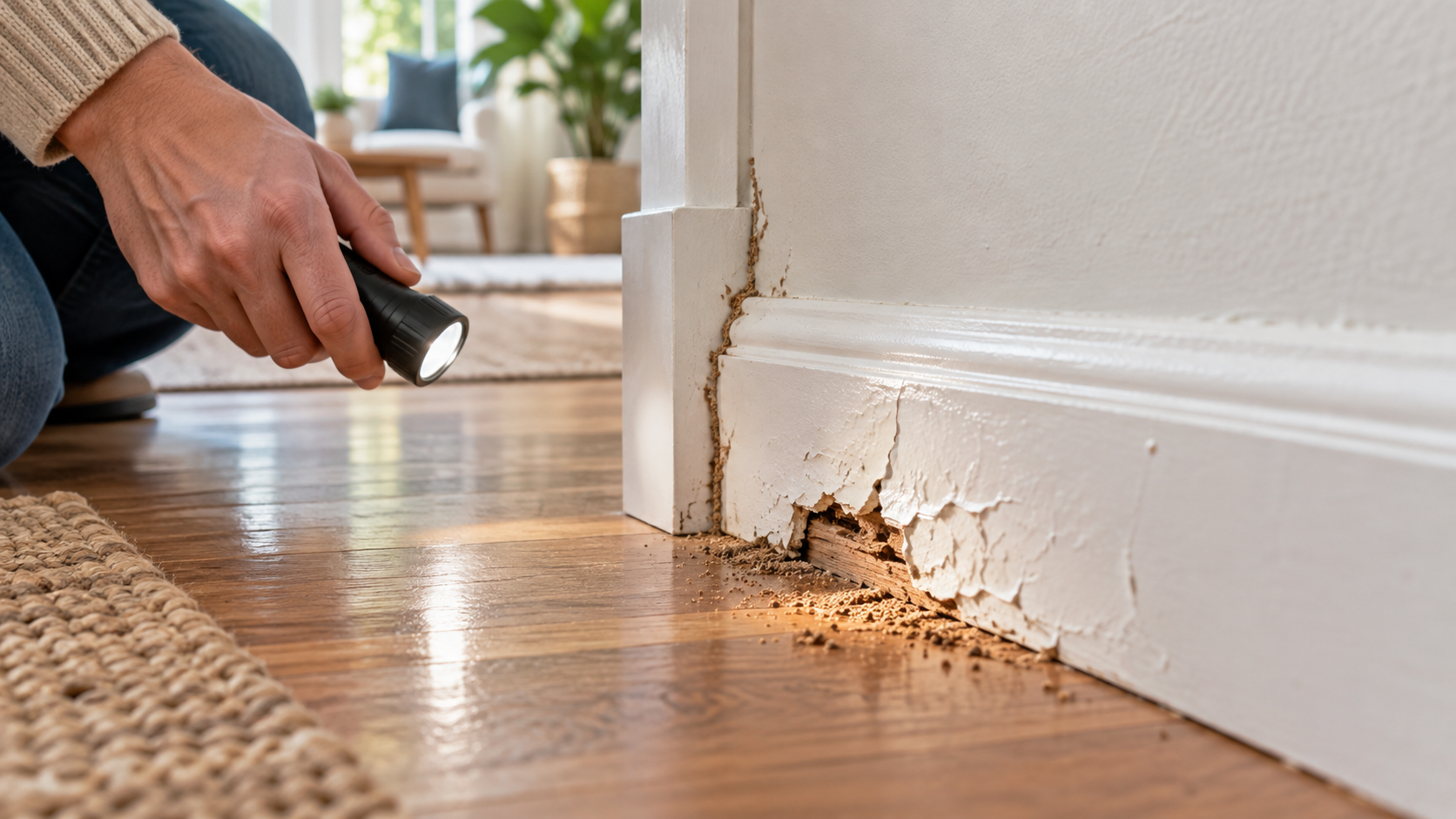
Then one afternoon you notice something odd. A strip of paint looks slightly bubbled. One corner feels softer than it should. There is a tiny pile of what looks like sawdust near the wall.
And suddenly the baseboards are very interesting.
Termites can damage trim, wall framing, flooring, door frames, and other wood while staying largely hidden. That is what makes them frustrating. A termite problem may develop behind painted surfaces long before homeowners actually see an insect.
The signs of termites in baseboards are not always dramatic, either. You may notice a faint ripple in the paint, a hollow sound when tapping the wood, tiny pellets near the wall, or a baseboard that has become strangely brittle.
But there is an important catch: none of those signs automatically proves you have termites.
Water damage, wood rot, carpenter ants, beetles, poor paint adhesion, and ordinary wear can produce surprisingly similar symptoms.
So the goal is not to look at one blister and panic. It is to notice patterns.
Here is what to look for, what the different clues may mean, and when it is time to have the house inspected.
Why Termites Often Show Up Around Baseboards
Baseboards sit in a useful location for termites: right where the wall meets the floor.
That area can hide access points from wall cavities, floor framing, slab cracks, crawl spaces, foundations, and other structural wood.
Subterranean termites usually live in the soil and travel into buildings in search of cellulose. They can move through hidden mud tubes and enter wall systems without appearing in the open.
Drywood termites work differently. They can live directly inside dry wood and do not require the same connection to soil.
In either case, decorative trim may not be the original source of the problem. The visible baseboard can simply be the first place where hidden activity becomes noticeable.
That is why removing one damaged strip of trim does not necessarily solve anything.
The real question is what is happening behind it.
The Most Common Signs of Termites in Baseboards
Some termite clues are fairly distinctive. Others are annoyingly vague.
Pay particular attention when several of these appear in the same area:
- Baseboards that sound hollow when gently tapped
- Wood that feels unusually soft, thin, or brittle
- Paint that bubbles, blisters, or appears slightly raised
- Small cracks or warped sections of trim
- Tiny holes in the surface of the wood
- Small piles of hard pellet-like debris near the wall
- Mud tubes running along the foundation, wall edge, or behind trim
- Discarded insect wings near windows, doors, or baseboards
- Winged termites appearing indoors
- Wood that breaks open to reveal galleries or thin layered surfaces
- Baseboards separating from the wall without an obvious impact
- Repeated damage in nearby door frames, flooring, or wall trim
One clue alone may have another explanation.
Several together deserve more attention.
Hollow-Sounding Baseboards
Termites often consume the interior of wood while leaving a thin outer surface intact.
That can create a hollow or papery sound when you gently tap the trim.
The key word here is gently.
You do not need to attack the baseboard with a screwdriver to perform your own archaeological dig.
If one section sounds noticeably different from the surrounding trim, make a note of it. Compare the same type of baseboard in another room.
Hollow wood can be associated with termite feeding, but it can also result from construction details, previous repairs, or decay.
Think of it as a clue, not a verdict.
Soft or Brittle Wood
Healthy painted wood trim should feel solid.
Termite-damaged wood may become fragile enough to break or crush under relatively little pressure because much of the interior has been eaten away.
Sometimes the painted surface remains surprisingly normal.
Then a small bump from a vacuum cleaner or piece of furniture suddenly breaks through it.
That can reveal a thin outer shell with damaged wood underneath.
Water-damaged baseboards can also become soft, though. If the area is near a bathroom, exterior door, plumbing fixture, basement wall, or known leak, moisture should be considered at the same time.
Bubbling or Blistering Paint
This one causes plenty of false alarms.
Paint that looks bubbled, wrinkled, or slightly raised can sometimes appear over termite-damaged wood.
But moisture is a very common cause of bubbling paint.
A leaking pipe, wet drywall, condensation, exterior water intrusion, or repeated floor cleaning can all affect paint and trim.
Termites themselves are not eating the paint.
The visual change happens because the wood underneath has been damaged or because moisture conditions around the infestation affect the surface.
If the baseboard has bubbling paint plus hollow wood, insect debris, mud tubes, or nearby winged termites, the termite possibility becomes more convincing.
Mud Tubes Near the Baseboard
Mud tubes are one of the more recognizable signs of subterranean termites.
They look like narrow lines or small tunnels made from soil and other material.
You may find them on concrete foundations, basement walls, crawl-space supports, slab edges, pipes, or areas where walls meet the floor.
The tubes help termites travel between the soil and a food source while maintaining the protected environment they need.
A tube disappearing behind the baseboard is worth investigating.
But even an old-looking tube matters.
You cannot reliably determine the status of the entire colony just because one section looks dry or appears abandoned.
Tiny Pellet-Like Debris Near the Wall
Small piles of pellets can point toward drywood termites.
Drywood termites push waste material, commonly called frass, out of their galleries through small openings.
The result may look like tiny grains collected below a hole in wood trim, window frames, furniture, or other wooden surfaces.
People often describe it as sawdust, but termite pellets are not exactly the same as ordinary sawdust.
They tend to be small, dry, relatively uniform pellets rather than fluffy wood shavings.
If you clean up the pile and a similar pile appears again in the same place, that is useful information for an inspector.
Small Holes in Baseboards
Tiny holes can occur around termite activity, especially with drywood termites.
But holes in wood are not termite-exclusive.
Wood-boring beetles, nails, old installation points, and previous repairs can leave similar marks.
Look around the hole.
Is there fresh pellet material underneath?
Has the surrounding trim become brittle?
Are there similar holes elsewhere?
The surrounding evidence often matters more than the hole itself.
Discarded Wings Around Baseboards and Windows
Winged reproductive termites, called swarmers, leave established colonies to form new ones.
After a short flight, they shed their wings.
That can leave small piles of matching wings near windowsills, sliding doors, vents, light sources, or along the floor.
Finding a single random insect wing is not terribly informative.
Finding dozens of similar wings inside the home is different.
Indoor termite swarmers are one of the clearer reasons to arrange an inspection, particularly when they appear away from an open exterior door or window.
Winged Termites vs. Winged Ants
They are easy to confuse at a quick glance.
Both termites and ants can produce winged reproductive insects.
Termite swarmers generally have a relatively straight waist, straight-looking antennae, and two pairs of wings that are similar in length.
Winged ants typically have a narrower waist, elbowed antennae, and front wings that are noticeably larger than the rear wings.
You do not need to become an amateur entomologist overnight.
If you can safely collect a specimen in a small container or take a sharp close-up photo, that can help a pest professional identify it.
What Termite-Damaged Baseboards Can Look Like
| What You Notice | Possible Termite Connection | Other Common Explanations |
|---|---|---|
| Hollow sound | Internal galleries may have removed part of the wood | Construction gaps or previous damage |
| Soft trim | Wood may be hollowed from inside | Moisture damage or wood rot |
| Bubbling paint | Hidden wood damage may distort the surface | Leaks, humidity, poor paint adhesion |
| Small pellet piles | Can indicate drywood termite frass | Wood-boring insects or household debris |
| Mud-like lines | May be subterranean termite shelter tubes | Dirt or dried construction material |
| Tiny holes | Possible drywood termite kick-out openings | Beetles, nails, old repairs |
| Discarded wings | Possible termite swarm nearby | Flying ants or other insects |
Subterranean Termites and Baseboards
Subterranean termites are widespread across much of the United States.
They live in colonies associated with soil and travel to wood through protected routes.
A baseboard infestation may actually originate below the house or behind the wall.
In slab-on-grade homes, termites may enter through expansion joints, utility penetrations, cracks, or hidden gaps where the structure meets the foundation.
In crawl-space homes, activity may begin around sill plates, floor joists, support posts, or other accessible wood.
By the time the decorative baseboard looks damaged, the termites may have already traveled through other structural areas.
That is why simply replacing the visible wood is not enough.
Drywood Termites and Baseboards
Drywood termites are more common in warmer parts of the United States, especially some southern and coastal areas.
Unlike subterranean termites, they can establish colonies directly inside dry wood.
They do not need continuous contact with soil.
One of the more useful clues is the appearance of dry pellet-like frass below small openings in wood.
Drywood activity may be relatively localized compared with a large subterranean colony, but finding one damaged board does not tell you the full extent of the infestation.
Nearby framing, trim, furniture, or other wood may also need inspection.
Are Termites Eating the Drywall Too?
Termites are interested in cellulose, and the paper facing on drywall contains cellulose.
That means termite activity can sometimes affect drywall coverings or create visible changes on wall surfaces.
However, the structural wood behind the drywall is usually a bigger concern.
You may notice small marks, slight bubbling, or unusual surface damage before realizing there is activity inside the wall cavity.
Again, wall damage has many possible causes.
Do not assume every drywall blemish means termites.
Termite Damage vs. Water Damage
This is probably the most common point of confusion.
Both termites and moisture can cause soft wood, peeling paint, warped trim, and damaged walls.
The difference often becomes clearer when you look at the full picture.
| Clue | More Consistent With Termites | More Consistent With Moisture |
|---|---|---|
| Mud tubes | Yes, especially subterranean termites | No |
| Uniform dry pellets | Can indicate drywood termites | Usually no |
| Musty smell | Not a reliable termite sign alone | Common with persistent moisture |
| Water staining | Can coexist with termites | Strong moisture clue |
| Swarmers or shed wings | Strong insect clue | No direct connection |
| Rotting wood | May occur alongside infestation | Common with long-term dampness |
And yes, you can have both problems at once.
Damp conditions can make parts of a property more attractive to some termite species while also causing ordinary wood deterioration.
Termites vs. Carpenter Ants
Carpenter ants damage wood differently from termites.
Termites consume cellulose as food.
Carpenter ants generally excavate wood to create galleries.
Carpenter-ant galleries often appear smoother and cleaner, while termite galleries may contain soil or other material depending on the species.
Ant activity can also create piles of debris containing wood fragments and insect parts.
If the evidence is hidden behind a finished wall, however, distinguishing the two without opening anything may be difficult.
An inspection is usually faster than guessing for a week based on photos from the internet.
Does a Hollow Baseboard Mean the House Has Major Damage?
Not necessarily.
A small amount of trim damage can be localized.
But the opposite is also possible: a small visible area may be the tip of a larger hidden problem.
Termite damage does not spread in a neat, predictable rectangle around the part you can see.
Inspectors may check nearby framing, floor systems, crawl spaces, basement areas, foundation edges, attics, window frames, and other possible activity points depending on the property.
The condition of the structural wood is much more important than the cosmetic appearance of one baseboard.
What to Do if You Find Possible Termite Damage
You do not need to demolish the wall that evening.
A more useful response is to document what you found and avoid disturbing the area unnecessarily until it can be identified.
- Take clear photos of the damaged baseboard and nearby area
- Photograph mud tubes, wings, pellets, or insects before cleaning them up
- Save an insect specimen if you can do so safely
- Check adjacent rooms for similar signs
- Look for obvious moisture or plumbing problems nearby
- Avoid covering the damaged area with new trim before inspection
- Arrange a professional termite inspection when the evidence is convincing or recurring
- Ask the inspector what species or type of activity they found
- Request an explanation of how far the inspection suggests the problem extends
Spraying a random household insecticide into a crack is not a substitute for identifying where the colony is located and how it is entering the structure.
Should You Pull Off the Baseboard Yourself?
Sometimes removing trim reveals useful evidence.
But it can also destroy clues, expose hidden wiring, damage drywall, or turn a small repair into a bigger one.
If you already have clear evidence of termite activity, leaving the area intact for an inspector can make identification easier.
If the baseboard has already broken open naturally, take photographs before cleaning or repairing it.
Homeowners are understandably curious.
Curiosity just does not require turning the hallway into a demolition project at 10 p.m.
How a Professional Termite Inspection Works
An inspection usually starts with visible and accessible parts of the home.
The inspector looks for insects, wings, shelter tubes, wood damage, moisture conditions, entry points, and other evidence consistent with termite activity.
Depending on the property, crawl spaces, basements, attics, garages, exterior foundations, decks, and interior trim may all be relevant.
Some professionals may also use moisture meters or other inspection tools.
No inspection method can magically see every inch inside every closed wall, but experienced inspectors know where termite activity commonly appears and which clues deserve follow-up.
Can You Have Termites Without Seeing Any?
Absolutely.
That is normal.
Worker termites generally avoid open, dry, brightly exposed areas.
Much of their activity happens inside wood, soil, wall cavities, or protected tubes.
A homeowner may never see active workers.
The first clue could be damage, frass, shelter tubes, or a seasonal swarm.
So “I haven’t seen any bugs” does not rule out termites.
What Time of Year Are Termite Signs Most Noticeable?
Termites can remain active inside a structure without an obvious seasonal display.
Swarming, however, tends to be seasonal and varies by termite species and climate.
Many subterranean termite species swarm during warmer periods, often after favorable combinations of temperature and moisture.
Drywood termite swarming patterns can differ and are more relevant in regions where those species occur.
The important part is not memorizing a month.
If winged termites appear indoors, take it seriously regardless of what your calendar says.
Why Moisture Around Baseboards Matters
Persistent moisture is bad news for building materials even when termites are not involved.
Leaking plumbing, poor exterior drainage, wet crawl spaces, roof leaks, condensation, and water intrusion can all damage wood.
They may also create conditions favorable to certain termite activity.
So if an inspector finds termites near a chronically damp wall, solving only the insect problem may leave an important contributing condition untouched.
Fix the moisture source too.
How to Reduce the Chance of Future Termite Problems
There is no magic trick that makes a wood-framed house permanently termite-proof.
There are, however, several sensible habits that reduce attractive conditions and make activity easier to detect.
- Repair plumbing, roof, and drainage leaks promptly
- Keep gutters and downspouts functioning properly
- Avoid storing firewood directly against the house
- Keep wood debris away from foundation areas
- Reduce unnecessary wood-to-soil contact
- Keep foundation and crawl-space areas accessible enough for inspection
- Watch for moisture around basement and crawl-space wood
- Inspect suspicious mud tubes rather than simply painting over them
- Pay attention to swarming insects indoors
- Have high-risk properties inspected periodically
Most of these steps are not glamorous.
They are effective precisely because they deal with the boring conditions that pests quietly take advantage of.
Can Newer Homes Get Termites?
Yes.
A newer house is not automatically protected forever.
Construction methods, preventive treatments, building codes, and local termite pressure vary across the country.
A home can also develop new vulnerabilities after landscaping changes, additions, plumbing work, moisture problems, or changes around the foundation.
Do not dismiss suspicious signs simply because the house is only a few years old.
Do Termites Only Attack Old Wood?
No.
Termites are not waiting for wood to become antique.
Accessible cellulose is the key attraction.
New framing can be attacked under the right conditions just as older wood can.
Age may affect how much wear, moisture exposure, or previous pest history a house has accumulated, but termites do not require old timber.
Are Termites Dangerous to People?
Termites are mainly a structural and financial concern rather than a direct human health threat.
They are not known for aggressively attacking people inside homes.
The concern is what prolonged hidden feeding can do to wooden materials.
Severe structural damage can eventually affect floors, walls, stairs, porches, or other components if the infestation is ignored long enough.
The earlier the problem is identified, the more manageable the repair usually becomes.
Can You Just Replace the Damaged Baseboard?
You can replace damaged trim after the termite issue has been addressed and the underlying area has been evaluated.
Replacing it first is mostly cosmetic.
If active termites remain behind the wall, a beautiful new piece of trim changes very little.
Once the infestation is treated, damaged material can be assessed.
Minor trim may simply need replacement. Structural framing with significant damage may need repair by a qualified contractor.
The pest treatment and the carpentry repair are related jobs, but they are not the same job.
When Damage Becomes a Structural Concern
Baseboards themselves are decorative trim.
The bigger concern is whether nearby framing has also been damaged.
If floors feel soft or uneven, door frames have shifted, structural wood has visible galleries, or large areas of framing appear compromised, further evaluation may be needed.
A pest professional can identify infestation activity.
A contractor, engineer, or other appropriate building professional may be needed when the question becomes structural strength.
Do not assume the entire house is unsafe because one baseboard is damaged.
And do not assume everything is fine because the damaged section is small.
How Quickly Do Termites Destroy Wood?
There is no useful universal countdown.
The rate depends on the termite species, colony size, environmental conditions, available food, and the wood itself.
Significant structural damage generally develops over time rather than overnight.
That is good news in one sense.
You usually have time to arrange a proper inspection rather than making a rushed decision based on fear.
But it is not a reason to ignore confirmed activity for months or years.
Should You Get More Than One Termite Estimate?
For a significant treatment proposal, getting another professional opinion can be useful.
Compare more than the dollar amount.
Ask what evidence was found, what type of termite is involved, where activity was located, what treatment is being proposed, what areas are included, and what follow-up comes with the service.
If two companies give completely different explanations for what is happening, ask both to show you the evidence.
You should understand what you are paying to fix.
FAQ
What are the first signs of termites in baseboards?
Early signs can include hollow-sounding trim, soft spots, bubbling paint, small holes, mud tubes, pellet-like frass, discarded wings, or unusual damage along the wall edge. No single symptom proves termites, so look for several clues together.
Do termites leave sawdust near baseboards?
Drywood termites can leave small piles of pellet-like frass near openings in infested wood. It is often mistaken for sawdust. Subterranean termites generally do not create the same type of dry pellet pile.
Can termite damage look like water damage?
Yes. Both can cause soft wood, warped trim, peeling paint, and surface changes. Mud tubes, termite swarmers, matching discarded wings, or drywood termite pellets make an insect problem more likely, while obvious staining and persistent wetness point more strongly toward moisture.
Why does my baseboard sound hollow?
Termites can eat the interior of wood while leaving a thin outer layer, creating a hollow sound. However, construction gaps, rot, or previous damage can do something similar. A hollow sound is useful evidence but not a diagnosis by itself.
Should I remove a baseboard if I suspect termites?
Not necessarily. Removing trim can destroy useful evidence and damage the wall. If you already have suspicious signs, document them and consider having the area inspected before pulling everything apart.
Does seeing one termite mean there is an infestation?
One unidentified insect does not prove a structural infestation. However, multiple termite swarmers indoors, discarded wings, mud tubes, or damaged wood deserve professional attention because termites usually live in colonies rather than as isolated household insects.
Can I repair termite-damaged baseboards myself?
Cosmetic baseboard replacement may be a manageable home repair after the termite problem has been identified and addressed. Do not treat replacing the trim as termite treatment. Hidden wall or structural damage may require professional repair.
Conclusion
Signs of termites in baseboards are easy to overlook because the first changes can be small.
A blister in the paint.
A strange hollow sound.
A few wings on the floor.
A tiny pile of pellets you vacuum up and forget about.
None of those things alone means the house is being eaten from the inside.
But patterns matter.
Hollow or brittle trim combined with mud tubes, termite swarmers, discarded wings, frass, or visible internal galleries deserves attention.
The same is true when damage keeps returning after you clean or repaint the area.
Do not focus only on the baseboard itself.
Decorative trim may be the first visible symptom of activity occurring behind the wall, below the floor, or around the foundation.
That is why simply installing a fresh piece of trim does not solve a termite infestation.
First identify what caused the damage.
If moisture is responsible, repair the moisture problem.
If termites are active, deal with the infestation and determine whether nearby wood needs evaluation.
If you are not sure what you are looking at, a professional inspection can save a lot of guessing.
And try not to panic.
Termite activity is a serious home-maintenance issue, but finding suspicious signs does not automatically mean the house has catastrophic structural damage.
Many infestations are discovered and treated before they reach that point.
The useful habit is simple: notice changes.
Look at the baseboards when paint starts bubbling for no obvious reason. Pay attention when trim suddenly feels soft. Do not repeatedly sweep away strange pellets without asking where they came from.
And if winged termites appear indoors, take a photo before reaching for the vacuum.
A little evidence can make identification much easier.
Baseboards are not usually the most interesting feature in a home.
When they start behaving strangely, though, they are worth a second look.
Leave a Reply