
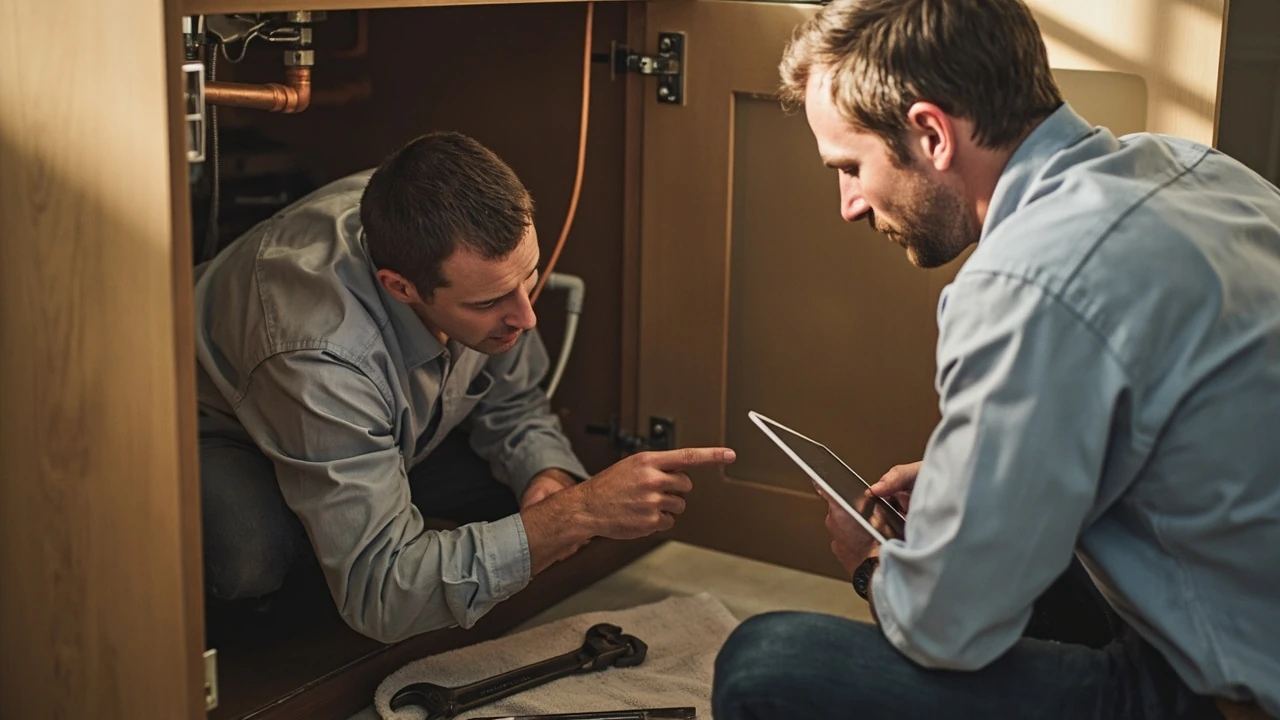
Plumbing contractors: what they actually do and how to hire one well
A homeowner in a 1990s two-story house notices a recurring damp spot under the kitchen sink, a water heater that rumbles through the night, and a slow drain in the guest bathroom that has resisted every store-bought cleaner. None of these problems are dramatic, yet together they point to a single decision most homeowners face at some point: whether to call a handyperson, a dedicated plumber, or a full-service plumbing contractor. The difference between those three options, and the difference between a good and a bad hire, is usually the difference between a one-day fix and a three-month headache with drywall stains, insurance questions, and a re-inspection.
Plumbing contractors are licensed businesses that plan, install, repair, and replace water supply, drain, waste, vent, and gas piping systems in residential and commercial buildings. Unlike a solo plumber who may only show up to clear a clog, a contractor typically holds the company license, pulls permits, carries liability and workers’ compensation insurance, and employs or subcontracts a team that can handle larger projects such as repipes, sewer line replacements, and full bathroom builds. Knowing which kind of professional your project requires, and how to evaluate them, is the practical core of this guide.
What plumbing contractors actually handle
The term “plumbing contractors” covers a wider range of work than many homeowners expect. A residential plumbing contractor may be called in for jobs as small as replacing a pressure-reducing valve and as large as replumbing a multi-story home or installing a new sewer connection to the street. Understanding that range helps you describe your project accurately when you request quotes.
- Service and repair: leak diagnosis, fixture replacement, water heater repair, sump pump installation, drain cleaning, and emergency shutoff valve replacement.
- Remodel and rough-in: new bathroom or kitchen layouts, relocating supply and drain lines, installing manifolds, and pressure testing before walls are closed.
- Repipe projects: replacing aging galvanized, polybutylene, or lead piping with copper, PEX, or CPVC systems.
- Sewer and water service: exterior water service lines, septic tie-ins, and main drain replacement, often coordinated with excavation or trenchless equipment.
- Gas piping: in many jurisdictions, the same licensed contractor handles interior gas lines for ranges, dryers, and water heaters, subject to separate permits and pressure tests.
- Backflow prevention and testing: installation and annual certification of backflow devices required by many municipal water authorities.
Trade bodies such as the Association of Plumbing and Heating Contractors, which represents plumbing and heating businesses in England and Wales, have historically grouped these activities under a single specialist remit, reflecting how rarely water, drain, and gas work sit cleanly in separate boxes. In the United States, the equivalent structure is usually a state-licensed plumbing contractor with classifications for residential, commercial, and service work, plus local jurisdictional permits.
Plumber vs. plumbing contractor vs. handyperson
These three titles are often used interchangeably, but the legal and practical distinctions matter when you sign a contract or pull a permit. The table below summarizes the most common differences; exact rules vary by state, county, and municipality, so use it as a starting point, not a legal opinion.
| Role | Typical licensing | Typical scope | Permit authority | Insurance expectations |
|---|---|---|---|---|
| Handyperson | Often no plumbing license, sometimes a general home-maintenance registration | Minor fixes such as replacing a faucet cartridge, swapping a showerhead, or installing a disposal where no permit is required | Cannot pull plumbing permits in most jurisdictions | General liability only; rarely carries workers’ comp for plumbing-specific risk |
| Licensed plumber (individual) | State journeyman or master plumber license | Diagnostic, repair, and installation work under the supervision of, or on behalf of, a licensed contractor | Works under a licensed contractor for permit work | Covered as an employee or subcontractor under the contractor’s policy |
| Plumbing contractor (company) | State plumbing contractor license, often requiring a master plumber as the qualifying party | Full-scope plumbing including permitted remodels, repipes, sewer, and gas; holds the business license and warranty responsibility | Pulls and closes plumbing permits | General liability, workers’ compensation, and often commercial auto coverage |
If a project requires opening walls, relocating fixtures, replacing a water heater in a jurisdiction that requires a permit, or running new gas piping, a licensed plumbing contractor is almost always the correct level of hire. A handyperson may be appropriate for purely cosmetic fixture swaps where local code does not require a permit and no drain or supply lines are altered.
When you actually need a plumbing contractor
Not every drip needs a contractor. A useful mental test is whether the work changes the system behind the wall or floor, or simply replaces a user-serviceable part. The list below covers situations where calling a licensed plumbing contractor is the safer and usually code-required choice.
- Water heater replacement, including conversion between fuel types or relocation of the unit.
- Any work that requires opening a wall, ceiling, or floor to access supply, drain, or vent lines.
- Sewer line repair or replacement, including trenchless methods.
- Gas line installation, extension, or modification for appliances.
- Installation of a backflow preventer, pressure-reducing valve, or main shutoff that affects the whole house.
- Whole-home repipe due to aged or problematic piping materials.
- Bathroom or kitchen additions where new rough-in is required.
For a slow drain, a running toilet, a dripping faucet, or a garbage disposal that has stopped working, a service plumber dispatched by a plumbing contractor is usually enough. The contractor is still the right entity to call, because they are the ones employing or credentialing the service tech and standing behind the warranty.
How plumbing contractors price their work
Pricing structure is one of the most practical pieces of information a homeowner can collect, because it changes how you compare quotes. There is no national standard, but most residential plumbing contractors use a mix of the methods in the table below.
| Pricing model | How it works | Best fit for | Watch for |
|---|---|---|---|
| Flat-rate menu pricing | The company assigns a fixed price per task from an internal price book, regardless of how long the job takes. | Common service calls with predictable scope, such as water heater swaps or toilet replacements. | Make sure the quoted flat rate includes haul-away, permit fees, and any required code upgrades. |
| Time and materials (T&M) | Hourly labor rate plus the cost of parts and a markup, billed after the work is done. | Diagnostic visits and older homes where unknowns behind the wall are likely. | Ask for a not-to-exceed figure and an estimate of how long the diagnostic phase will take. |
| Cost-plus or unit pricing | Contractor bills for each fixture, fitting, or linear foot of pipe at a set unit price. | Larger repipes, additions, and ground-up rough-in work. | Confirm which fittings and valves are included so you are not charged twice for the same item. |
| Design-build or project-based | A single fixed price for a defined scope, often used in remodels and commercial work. | Bathroom or kitchen remodels where drawings and fixture selections are complete. |
Two more pricing concepts are worth understanding before you compare bids. First, mobilization or trip charges are flat fees that cover the cost of dispatching a truck and a technician; they are often credited toward the job if you proceed. Second, allowances are dollar amounts the contractor sets for items you have not yet picked, such as a faucet or toilet, with the understanding that the final billing adjusts to the actual selection. Both should be itemized in writing.
Licensing, insurance, and permits: the non-negotiables
Skipping these checks is the single most common cause of disputes between homeowners and plumbing contractors. A For additional context, contractor’s license number is not just bureaucratic trivia; it ties the company to a master plumber, allows the jurisdiction to pull the permit, and is usually the only practical leverage you have if work is not performed to code.
- Verify the license: Look up the company on your state or local licensing board website. Confirm the license is active, the qualifying master plumber matches the name on the contract, and the license classification covers residential work.
- Ask for insurance certificates directly: Request a certificate of insurance showing general liability (often at least $1 million per occurrence) and workers’ compensation. Call the insurance carrier to confirm the policy is in force.
- Confirm who pulls the permit: In most jurisdictions, the contractor pulls the permit in their name, not yours. If a contractor asks the homeowner to pull an “owner-builder” permit for paid work, treat that as a serious red flag.
- Check complaint history: Your state contractor board, Better Business Bureau, and local building department are all sources of public complaint data. A pattern of unfinished jobs or permit failures is more telling than an isolated negative review.
For comparison, homeowners who pay attention to license and insurance details before signing tend to have shorter punch lists and fewer warranty disputes. The half hour spent on verification is the cheapest insurance you will ever buy on a project.
Reading and comparing plumbing contractor quotes
Two quotes that look similar on the bottom line can describe very different jobs. Comparing them line by line is the only reliable way to know which one you would rather have on the hook for the work. Use the checklist below as a starting framework.
- Scope of work: Written in enough detail that an outsider could understand what is being removed, installed, and left in place.
- Fixtures and materials: Brand, model, and size of the water heater, faucets, valves, and piping, including part numbers where possible.
- Permits and inspections: Who pulls, who pays, and how many inspections are expected.
- Warranty terms: Separate labor warranty and manufacturer warranty, with the start date and what is excluded.
- Cleanup and restoration: Whether drywall, tile, painting, and floor protection are in scope or left to others.
- Schedule and payment: Start date, completion window, deposit amount, and progress payment schedule.
Be cautious about a quote that is dramatically lower than the others. In plumbing, an unusually low bid often means the scope is missing something the others include, such as a permit, a code-required expansion tank, or haul-away of the old equipment. It can also mean the contractor is unlicensed or uninsured, which shifts risk back to you.
Questions to ask before signing a contract
Once you have narrowed the field to two or three plumbing contractors, the conversation shifts from credentials to fit. The questions below surface practical issues that rarely appear in marketing materials but matter once the truck is in the driveway.
- Who will be on site daily, and is that person a licensed journeyman or master plumber?
- What is the realistic start date, and what could push it later?
- How do you handle change orders, and at what dollar threshold do you need written approval?
- What is the labor warranty, and what is excluded?
- Do you subcontract any portion of the work, and if so, who?
- How are older or unexpected conditions, such as rotted subfloor or out-of-code venting, priced?
- Will you provide a written lien waiver at each progress payment?
Strong contractors answer these directly and in writing. A vague answer about subcontractors or change orders is a useful predictor of mid-project friction.
Working with plumbing contractors during the project
The contract phase ends when work begins, but the decisions you make during the project are just as important. A few habits keep the relationship productive and the punch list short.
- Keep a written change log, even for small verbal approvals, and email a confirmation to the project manager at the end of each day.
- Photograph any wall, floor, or ceiling opening before it is closed. Closed walls hide a great deal of useful evidence if a leak appears later.
- Ask for the pressure test results on any new water, drain, or gas line before drywall goes up. The reading belongs in the project file, not just in the contractor’s head.
- Schedule your own final walkthrough with the permit inspector if local rules allow it. Inspectors are a free second pair of eyes.
- Hold the final payment until the permit is closed out and you have the final lien waiver from every supplier and subcontractor.
For homeowners planning adjacent work, it is also worth coordinating trades. If a remodel is on the calendar, scheduling the remodeling contractor and plumbing contractor to walk the site together before either opens a wall prevents the classic “we thought they were doing that” problem. Likewise, exterior plumbing work such as a sewer line replacement sometimes overlaps with driveway or landscape restoration that is outside the plumber’s scope.
Red flags when evaluating plumbing contractors
Some warning signs are subtle and some are obvious, but all tend to show up early if you are paying attention. The list below is not exhaustive, but each item has been a recurring feature in homeowner complaints to licensing boards and consumer protection offices.
- Cash-only discounts, no written contract, or a contract that lists only a generic “plumbing work” line item.
- Pressure to start before the permit is pulled, or a request that you pull the permit yourself.
- Refusal to provide proof of insurance or a copy of the business license.
- A physical address that turns out to be a mailbox or a residential lot with no signage.
- Substantially lower pricing combined with a demand for a large upfront deposit.
- Negative reviews that all sound the same, or no reviews at all for a company that claims decades of experience.
None of these is automatically disqualifying on its own, but two or more together should move a contractor down your list. The cost of switching contractors mid-project is high, so the goal is to do the screening before signing.
Warranty, callbacks, and what to keep on file
Plumbing work that meets code still fails occasionally. A fitting can be defective, a solder joint can be dry, or a settlement in the yard can stress a sewer line. The difference between a minor inconvenience and a months-long argument usually comes down to documentation.
- Save the contract, the scope of work, the change order log, and the final invoice in both paper and digital form.
- Keep the permit card, the inspection sign-offs, and the pressure test readings together in one folder.
- Photograph or scan the manufacturer’s warranty cards for the water heater, fixtures, and any specialty valves.
- Note the date and details of every phone call with the contractor, especially any verbal commitments about callbacks.
If a callback is needed, raise it in writing with a clear description, photographs if relevant, and a reasonable deadline. Most reputable plumbing contractors respond faster to a written, dated request than to a phone call alone, because it is easier to route through the right person and to track in their own system.
Frequently asked questions
What is the difference between a plumber and a plumbing contractor?
A plumber is an individual tradesperson who diagnoses, repairs, and installs plumbing systems, usually as an employee or subcontractor. A plumbing contractor is a licensed business that holds the company license, pulls permits, carries insurance, and takes legal responsibility for the work. Service work can be done by either, but any job that requires a permit or a multi-day scope almost always goes through a contractor.
Do plumbing contractors need to be licensed?
Yes, in nearly every U.S. state and most local jurisdictions, plumbing contractors must hold a license, typically backed by a master plumber as the qualifying party. The exact license class, continuing education rules, and insurance minimums vary by state and county. Always verify the specific license your project requires before signing a contract.
How much do plumbing contractors typically charge?
There is no single national rate. Many companies charge a flat trip or diagnostic fee, hourly labor rates that vary by region, and parts at retail plus a markup. The best way to compare is to ask two or three licensed plumbing contractors for written quotes on the same scope, then compare line by line, not just on the bottom line.
Should I get multiple quotes for plumbing work?
For any work beyond a simple service call, yes. Three written quotes are a common rule of thumb. They give you a sense of the market price, expose scope gaps between bidders, and make it easier to push back on an unusually high or low number. For a one-visit repair, a single trusted contractor is often enough.
Are plumbing contractors responsible for pulling permits?
In most jurisdictions, the contractor pulls the permit in the company’s name. If a contractor asks the homeowner to obtain an owner-builder permit for paid work, that is a serious red flag. Permits exist to protect you, and the contractor is the party responsible for scheduling and passing inspections.
What insurance should plumbing contractors carry?
At minimum, general liability and workers’ compensation are standard. Many also carry commercial auto coverage for company vehicles. Ask for a current certificate of insurance and verify the policy directly with the carrier, because an expired or falsified certificate is a common gap.
Can plumbing contractors also do gas line work?
Often yes, but the license or endorsement required for gas piping is usually separate from the standard plumbing license, and a permit is almost always required. Confirm that the specific contractor holds the gas endorsement for your jurisdiction and that the scope of work explicitly covers pressure testing the new gas line.
How do I handle a dispute with a plumbing contractor?
Start with a dated, written description of the problem and a clear ask. If the contractor does not respond, escalate to the state contractor licensing board, which can suspend or revoke a license for nonperformance. Small-dollar disputes can often be resolved in small-claims court; larger ones may need an attorney who specializes in construction defect.
What is a reasonable warranty on plumbing work?
One year on labor is common, with manufacturer warranties on parts and fixtures ranging from one year to lifetime depending on the brand. Read the warranty section of the contract carefully, including any exclusions for freeze damage, abuse, or lack of maintenance, because those clauses are where most warranty disputes start.
How do I find a good plumbing contractor in my area?
Start with referrals from neighbors, your real estate agent, or a general contractor you already trust. Cross-check those names against your state licensing board, the Better Business Bureau, and recent online reviews that mention specific jobs rather than vague praise. A short list of two or three candidates will give you enough to compare without burning weeks of calendar time.
Leave a Reply