
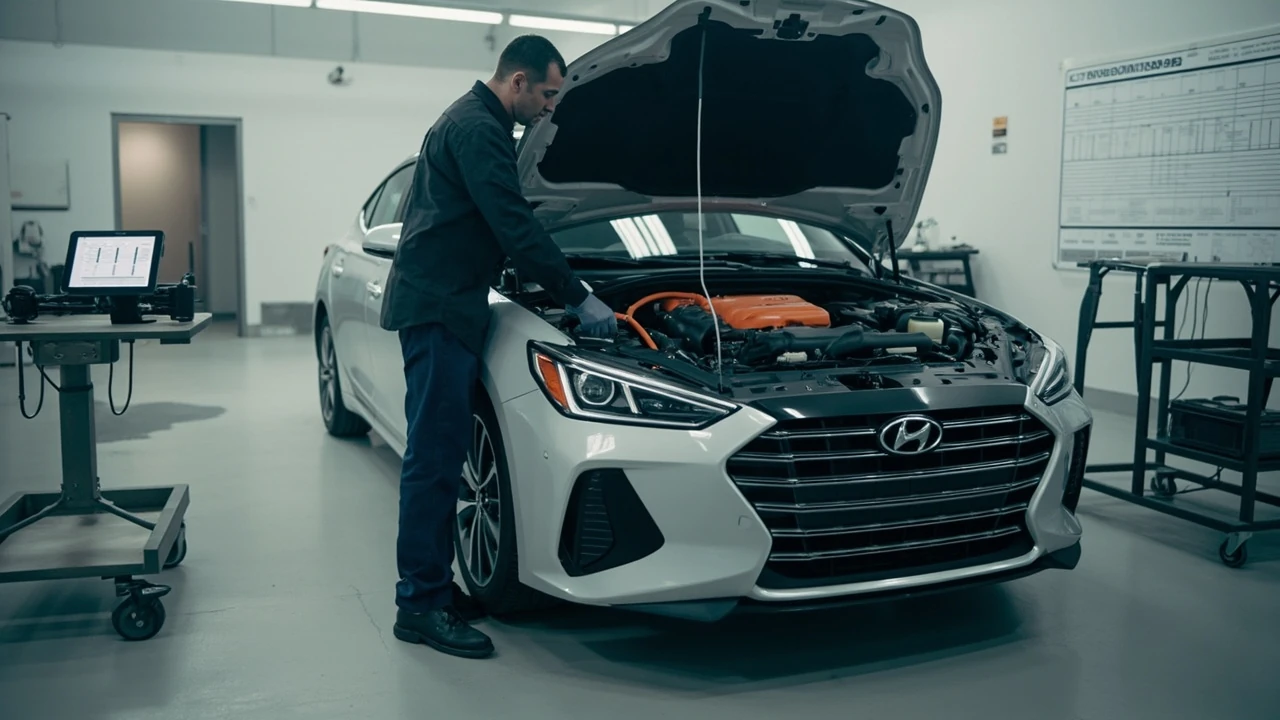
What a hybrid service actually covers and when to schedule one
A hybrid service is the scheduled maintenance visit designed specifically for vehicles that pair a gasoline engine with an electric motor and a high-voltage battery. It looks similar to a conventional oil-and-filter appointment from the outside, but the inspection list is longer, the safety steps are stricter, and the technician is checking components that simply do not exist on a purely gas-powered car. For owners, the practical question is usually not whether hybrid vehicles need service, but what the visit should actually include and how often it should happen.
This guide walks through the realistic scope of a hybrid service, the components that distinguish it from a standard visit, the intervals most manufacturers use, and the situations where the appointment should move sooner than the printed schedule suggests. The aim is to give owners a clear picture of what they are paying for and what they should ask the shop to verify.
Why a hybrid service is not just a standard oil change
Hybrid powertrains add a parallel set of systems on top of the familiar ones. The internal combustion engine still needs lubricants, filters, and coolant, but it shares the vehicle with a traction battery, an inverter, a DC-DC converter, regenerative braking hardware, and power electronics. Those parts are not serviced every visit, but they need to be inspected, and the technician has to know how to work around them safely.
The high-voltage system is the largest difference. Cables are usually coloured orange in North American vehicles to flag the circuit, and the battery pack, inverter, and converter all live in places a normal oil-change technician rarely opens. A shop that is not set up for hybrids may simply skip the high-voltage checks, which leaves the most expensive components in the car uninspected. A proper hybrid service, by contrast, treats the battery and electronics as part of the routine.
Hybrid-specific wear patterns also matter. The combustion engine runs less often and at lower average loads, so oil contamination and carbon build-up behave differently than in a conventional car. Brake pads often last longer because regenerative braking handles most of the stopping, but the rotors can develop surface corrosion from sitting. Cooling systems carry heat away from both the engine and the power electronics, so low coolant can cause two unrelated problems at once.
Core components inspected during a hybrid service
The exact checklist varies by manufacturer and by the type of hybrid (full, mild, or plug-in), but the categories below cover what a thorough visit should touch. If a shop is skipping any of these, it is worth asking why.
- Engine oil and filter: replaced on the manufacturer’s interval, which is often longer than for a conventional vehicle but still required because oil degrades with age as well as mileage.
- Hybrid battery health: scanned for state of health, cell voltage balance, pack temperature history, and error codes stored in the hybrid control module.
- Inverter and converter cooling: coolant level and condition checked, since these components generate significant heat under load.
- Regenerative braking system: function test to confirm the electric motor is contributing to braking and that friction brakes are blending correctly.
- 12-volt auxiliary battery: tested, because many hybrid systems will not start the high-voltage contactors if the 12-volt battery is weak.
- Brake fluid, transmission fluid, and engine coolant: inspected for level, colour, and contamination, with service recommended on the schedule rather than only on failure.
- Tires, alignment, and rotation: hybrids are heavier at the rear axle on many models, so even tire wear matters more than it would on a lighter car.
- Cabin air filter, engine air filter, and wiper blades: replaced or inspected on the same cycle as a conventional service.
How a hybrid service interval is set
Most manufacturers publish two numbers for each service: a mileage figure and a time figure, whichever comes first. For hybrids, the time figure is often the binding constraint, because the engine runs fewer hours per mile than in a conventional car. A driver who covers 4,000 miles a year on short trips may hit the 12-month service mark long before the mileage cap.
Typical intervals for mainstream hybrid models look roughly like the table below. Always check the owner’s manual for the specific vehicle, because warranty terms and component design both feed into the schedule.
| Service item | Typical interval | What happens if it slips |
|---|---|---|
| Engine oil and filter | Every 10,000 miles or 12 months | Increased engine wear, possible sludge, reduced fuel economy |
| Hybrid battery health scan | Every 12 months | Degraded cells or cooling faults go unnoticed until performance drops |
| Engine coolant | Every 60,000 to 100,000 miles | Overheating of engine and inverter, corrosion in the cooling passages |
| Transmission fluid (hybrid transaxle) | Every 30,000 to 60,000 miles | Harsh shifts on the mechanical portion of the drivetrain, increased wear |
| Brake fluid | Every 2 to 3 years | Reduced braking performance and risk of ABS faults during regenerative blending |
| Cabin and engine air filters | Every 15,000 to 30,000 miles | Reduced HVAC efficiency, increased engine intake restriction |
| 12-volt battery | Every 4 to 5 years | Vehicle fails to “ready” on, dashboard warnings, possible no-start condition |
| Tire rotation and alignment check | Every 5,000 to 7,500 miles | Uneven wear, reduced efficiency, noise from regenerative braking transitions |
Plug-in hybrids add two more line items. The charging port, onboard charger, and charge cable should be inspected annually for damage, and the high-voltage battery thermal management system benefits from the same coolant checks as the engine cooling circuit. Most plug-in hybrids also recommend a longer oil-change interval than their non-plug-in siblings because the engine runs even less, but the oil still ages in the pan.
What technicians do differently on a hybrid service
Before any work begins under the hood, the technician usually powers the vehicle down to a safe state and confirms the high-voltage system is isolated. That is a different routine from a conventional oil change, which can be done on a running engine if needed. The orange high-voltage cables are not touched during routine service, but the technician should still verify the system is in a service-safe condition before placing hands near inverters or the battery pack.
Diagnostic tooling also differs. Hybrid control modules store codes that a generic OBD-II scanner can read but cannot always interpret. A shop that services hybrids routinely will have a scan tool that talks to the battery energy control module, the inverter, and the regenerative brake controller, not just the engine and transmission modules. That extra layer of data is what allows the technician to spot a weak battery cell months before it triggers a warning light.
One often-overlooked step is the post-service road check. After a hybrid service, the technician should drive the vehicle briefly to confirm the transition between electric and gasoline power is smooth, the regenerative braking is engaging, and there are no warning lights after the system reboots. Skipping that drive means a small problem can leave the shop with the customer and reappear as a comeback the next day.
When to schedule a hybrid service sooner than the printed interval
Manufacturer schedules assume normal driving conditions. Real-world use often pushes the vehicle outside those assumptions, and a few specific patterns justify an earlier visit. The list below is not a maintenance plan on its own, but it is a reliable set of triggers for booking an appointment out of cycle.
- Dashboard hybrid system warning: any icon or message related to the hybrid battery, regenerative braking, or “check hybrid system” should be looked at within a few days, not at the next scheduled service.
- Sudden drop in fuel economy: if the car suddenly needs noticeably more fuel for the same commute, the battery may be holding less charge, the engine may be running more than usual, or a sensor may be reading incorrectly.
- Unusual noises on startup or shutdown: hybrids are usually quiet, so a clunk, whine, or hum that was not there before is worth investigating even if no light appears.
- Visible fluid leaks under the front or rear of the car: hybrids can leak coolant, transmission fluid, or hybrid-system coolant, and the colours are easy to confuse in a parking lot.
- After an accident or curb impact: high-voltage components are robust, but the orange cables, sensors, and battery mounting points should be inspected after any impact that would normally be checked for body damage.
- Before a long road trip: a pre-trip inspection is a small cost relative to a roadside failure, and the technician can flag items that would otherwise cause trouble far from home.
Cost drivers and what affects the price of a hybrid service
Pricing varies widely by region and by whether the shop is a dealer, an independent hybrid specialist, or a general repair shop. The main cost drivers are the same as for a conventional service, with a few additions.
| Cost driver | Why it affects a hybrid service | What owners can do |
|---|---|---|
| Shop type | Dealers tend to charge more per hour but have direct access to manufacturer tooling and recalls | Compare quotes from a dealer and a hybrid-focused independent shop for the same work |
| Fluid choices | Hybrid-spec coolant and transmission fluid can be more expensive than generic products | Ask which specification the shop is using and why, and confirm it matches the manual |
| Battery scan depth | A full state-of-health scan takes longer than a basic code read | Confirm the scan covers cell balance, not just whether the warning light is on |
| Filter and part quality | OEM filters and wiper blades usually cost more than aftermarket equivalents | Decide on quality tier before the work begins so the price does not change at pickup |
| Local labour rate | Hourly rates vary by city and shop type | Use the book time for the specific service as a reference, not just the headline price |
| Add-on inspections | Tire alignment, brake fluid exchange, and fuel system cleaning are usually optional | Ask which items are recommended by the manual and which are upsells |
Owners can keep the bill predictable by asking for a printed estimate that separates manufacturer-required items from suggested additional work, and by confirming the labour hours quoted against the published book time for the vehicle.
Common mistakes owners make with hybrid service
Most hybrid powertrains are reliable, but the service patterns around them sometimes go wrong. The mistakes below come up repeatedly in owner forums and in shop intake conversations, and they tend to shorten the life of either the battery, the engine, or the brakes.
- Skipping oil changes because the engine runs less. Oil still ages in the pan, and the moisture and fuel dilution that come from short trips are worse on a hybrid than on a conventional car.
- Ignoring the 12-volt battery. A weak 12-volt battery can prevent the high-voltage system from starting and may even damage the DC-DC converter if it is repeatedly deeply discharged.
- Replacing brake pads too early. Pads usually last much longer on a hybrid, but rotors can corrode if the car sits, so a periodic brake inspection is more useful than early pad replacement.
- Using non-hybrid coolant. Some manufacturers require specific coolant formulations for the inverter and battery cooling loop, and a generic green coolant can cause corrosion or blockages over time.
- Postponing battery diagnostics because the car still drives normally. Many hybrid battery packs show declining cell balance for months before the driver notices a problem, and a scan at service catches it early.
- Choosing a shop that does not service hybrids regularly. A general shop can change oil, but it may not have the scan tools, the safety procedures, or the fluid specifications for the hybrid components.
How to choose a shop for a hybrid service
Not every shop that can change a hybrid’s oil is the right place for a full service. A few questions help separate a general repair shop from one that handles hybrids as a routine part of its work. Asking these in advance saves both time and money.
- Does the shop have a scan tool that talks to the hybrid battery and inverter modules, or does it rely on a generic OBD-II reader?
- Are the technicians trained on high-voltage systems, and do they follow a documented lockout procedure before working near the orange cables?
- Which fluids and filters does the shop plan to use, and do those match the specification in the owner’s manual?
- Does the shop provide a written estimate that separates required maintenance from optional work?
- Can the shop show examples of similar hybrid models it services regularly, and is the labour rate quoted based on book time?
Independent hybrid specialists often charge less than dealers for the same work and may have more direct experience with the specific model. Dealers are usually the safer choice for warranty work, recalls, and software updates, and they have ready access to factory bulletins that independents do not. A practical approach is to compare both for non-warranty service, and to stay with the dealer while the car is under coverage for major systems.
Preparing for a hybrid service appointment
A small amount of preparation on the owner’s side makes the appointment faster and reduces the chance of follow-up calls. None of these steps require mechanical knowledge, and most take only a few minutes before dropping the car off.
- Note any warning lights, unusual sounds, or changes in fuel economy, even if they happened weeks ago and went away.
- List the driving conditions since the last service: long highway trips, short urban commutes, towing, extreme heat or cold, and rough roads all affect the service plan.
- Bring the owner’s manual or know the exact trim and model year, because service intervals and fluid specifications vary by configuration.
- Confirm whether the car is still under warranty, and which systems the warranty covers, so the shop does not bill for items that should be free.
- Ask whether a loaner vehicle, shuttle, or ride-share credit is available, since some hybrid services take longer than a standard oil change.
How a hybrid service changes as the vehicle ages
The early years of a hybrid’s life are usually the cheapest, because the battery is healthy, the brake system is largely regenerative, and the engine is still in its low-wear phase. From about year five to year ten, the service picture shifts. The 12-volt battery typically needs replacement once, the brake fluid becomes more important, and the hybrid battery begins to show the first signs of cell imbalance even on otherwise well-maintained cars.
Beyond ten years, two patterns dominate. Vehicles that received regular hybrid service tend to keep their original battery well past the point where neglected cars have already replaced theirs. Vehicles with irregular service history are the ones that show up in shops with a single weak cell pulling the whole pack down, and the conversation shifts from routine maintenance to battery repair or replacement. The single largest factor in which path a car follows is whether the hybrid service schedule has been kept.
None of this means a hybrid service is complicated or expensive. It means the schedule exists for a reason, and skipping it tends to push costs forward rather than remove them. A vehicle that receives the right service at the right intervals will usually outrun the average resale expectations for its class.
Practical next step for owners
If the vehicle is overdue for a service, the most useful first step is a short conversation with a hybrid-capable shop about the model’s specific schedule and the car’s recent driving pattern. A reliable resource on what a hybrid service visit includes is the explanation from a working shop’s overview of hybrid vehicle service and maintenance, which describes the dual-powertrain logic that drives the inspection list. For broader context on how hybrid powertrains combine a combustion engine with electric drive, the Wikipedia article on hybrid vehicle drivetrains is a useful reference on the underlying architecture that the service is designed to maintain. With that background, an owner can walk into the shop with a clearer picture of what should be inspected, what should be replaced, and what can wait until the next visit.
Frequently asked questions
Is a hybrid service more expensive than a regular service?
It is usually a little more expensive, mostly because the inspection list is longer and the technician needs hybrid-specific training and tools. The actual parts are similar to a conventional service, with the addition of a battery health scan and sometimes a coolant service for the inverter loop.
How often does a hybrid need a service?
Most hybrids follow a 12-month or 10,000-mile basic interval, with longer intervals for items like coolant and transmission fluid. Plug-in hybrids and vehicles used mostly for short trips should be serviced on the time interval even if the mileage is low.
Can any mechanic perform a hybrid service?
A general mechanic can handle oil changes and filters, but a full hybrid service benefits from a technician trained on high-voltage safety and equipped with scan tools that read the hybrid battery and inverter modules. For anything beyond basic maintenance, a hybrid-capable shop or dealer is the safer choice.
What happens if a hybrid service is skipped?
Skipping service usually does not cause an immediate failure, but it allows small problems such as low coolant, weak 12-volt batteries, and unbalanced battery cells to grow into larger ones. Over time, the result is higher repair costs and a shorter life for the hybrid battery.
Do hybrid brakes need servicing at every visit?
Not at every visit, but they should be inspected regularly. The pads usually last longer than on a conventional car, but the rotors can develop surface corrosion if the car sits, and the brake fluid still needs to be exchanged on its own schedule.
Does the hybrid battery get replaced during a routine hybrid service?
No. A routine service inspects the battery and reads its state of health, but replacement is only done when a pack has failed or has dropped below the manufacturer’s performance threshold. Most hybrid batteries last well past the first decade of service with regular maintenance.
Are there hybrid services that can be done at home?
Owners can safely check tire pressure, cabin filters, and washer fluid at home, and many of the inspection steps can be done visually by someone with basic mechanical knowledge. Any work that involves the high-voltage system, coolant service, or battery diagnostics should be left to a trained technician.
What is the difference between a hybrid service and an EV service?
An EV service focuses on the high-voltage battery, charger, reduction gear, and thermal management, without the engine oil, spark plugs, or exhaust work that hybrids still need. The hybrid service combines the EV-style battery and electronics checks with the conventional engine service that a battery-only car does not require.
Should plug-in hybrids follow a different service schedule?
Plug-in hybrids share most of the hybrid service schedule, with two additions: an annual check of the charging port, cable, and onboard charger, and closer attention to the high-voltage battery thermal system. The engine oil interval is often longer because the engine runs even less than in a standard hybrid.
How long does a hybrid service take at the shop?
A standard hybrid service that includes an oil change, filters, a battery health scan, and a multi-point inspection usually takes between two and four hours. Services that include coolant exchanges, transmission fluid, or brake fluid take longer, and dealer visits may run to a full day depending on scheduling.
Leave a Reply