
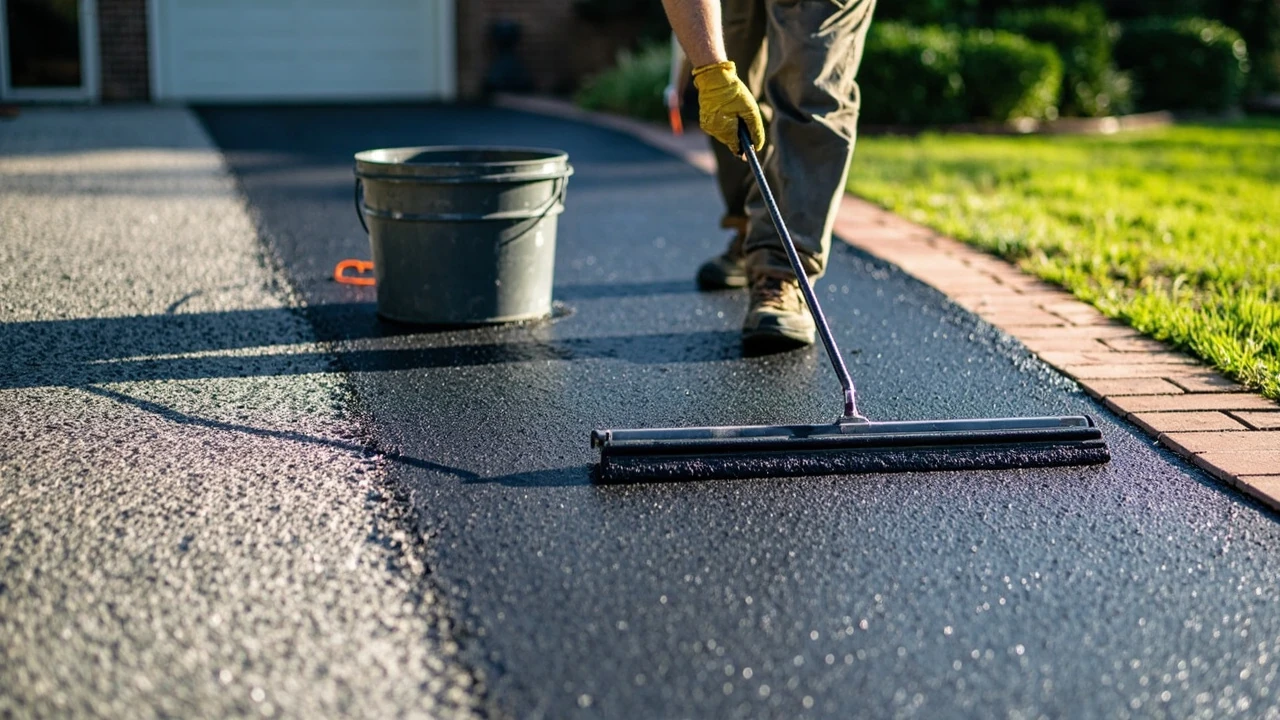
Seal coating for asphalt: what it is, when it helps, and where it falls short
A new asphalt driveway looks dense, dark, and almost indestructible for the first season. By the second winter the same surface starts to fade to gray, the edges feel powdery, and a few hairline cracks appear near the wheel paths. That visible change is not cosmetic. The dark color is the bituminous binder that holds the aggregate together, and the moment it starts to oxidize, the surface loses flexibility and begins to absorb water instead of shedding it. Seal coating is a maintenance layer applied over the top of asphalt to slow that process, restore the dark color, and buy several more years of service from a surface that would otherwise be replaced.
This guide explains how seal coating actually works, when it is worth doing, what it costs in real terms, and where it gets oversold. It is written for a homeowner or property manager who wants to make a confident decision about a service that is often marketed with vague promises and a wide range of prices.
How seal coating actually protects asphalt
Asphalt is a mixture of crushed stone, sand, and a petroleum-based binder. The binder is the part that fails first. Sunlight, oxygen, water, and automotive fluids all break it down over time, and once the binder loses its flexibility, the aggregate loosens and the surface raveles. Seal coating is a thin liquid layer, usually bituminous or acrylic, mixed with water, silica sand, and various fillers, that is spread across the top of the pavement and left to cure. Once cured, it acts as a sacrificial skin that takes the abuse instead of the asphalt underneath.
The protection is real but limited. A sealed surface will shed water more effectively, resist oil drips, and reflect more UV radiation. It will not fix structural failure, stop a crack that is already moving, or compensate for a base that was too thin in the first place. Anyone who promises that seal coating will make a cracked, soft driveway last forever is selling past the material’s actual limits.
When seal coating makes sense and when it does not
The decision to seal coat is really a decision about timing and condition. Done too early, on a surface that is still bleeding asphalt oils, the sealer will not bond. Done too late, on a surface that is already alligatored or potholed, the sealer becomes a cosmetic cover over structural damage. The window for useful seal coating is narrower than most marketing suggests.
Signs that a driveway is ready for seal coating
- Color has shifted from near-black to medium gray, but the surface is still sound.
- Sand and small aggregate start to collect at the low edge after rain.
- Hairline cracks are present but the surrounding pavement has not moved or settled.
- The driveway is at least 90 days old, and ideally through one full summer.
- No fresh oil stains, no soft spots, and no heaving from tree roots.
Situations where seal coating is the wrong call
- The surface has widespread alligator cracking, which signals base failure.
- There are depressions that hold water, which need patching or resurfacing first.
- Edges are broken and raveling heavily, which usually means the base is too thin.
- The driveway is less than 90 days old and still curing.
- The owner expects seal coating to stop a crack that is still actively moving.
DIY seal coating versus hiring a contractor
Most homeowners can seal coat a residential driveway themselves, and many do. The job is physically demanding, time sensitive, and unforgiving of bad weather, but it is not technically complex. A contractor brings faster equipment, a higher daily volume, and usually a more consistent finish, but the cost per square foot is several times higher than a DIY job. The right answer depends on the size of the driveway, the homeowner’s time, and tolerance for risk.
| Factor | DIY seal coating | Professional seal coating |
|---|---|---|
| Typical material cost per square foot | About $0.10 to $0.25 for a quality 5-year sealant | Usually included in the contract price |
| Typical labor cost per square foot | Your own time, often a full day for a two-car driveway | Roughly $0.35 to $0.75 depending on region and prep |
| Equipment needed | Squeegee or brush, crack filler, blower, hose, mixer | Tank sprayer, squeegee rig, line striper if applicable |
| Finish consistency | Varies with experience, may show lap marks | Usually more uniform with spray application |
| Best fit | Smaller driveways, cost-sensitive owners, flexible schedule | Larger driveways, commercial lots, owners who want a warranty |
| Main risk | Poor prep or weather window that ruins the coat | Contractor cuts prep to lower the bid |
Choosing a seal coating product
Seal coating products fall into a few families, and the differences matter more than the marketing claims suggest. Coal tar based sealers dominated the market for decades because they resist oil and gasoline well, but many municipalities have restricted or banned them because of concerns about runoff. Asphalt emulsion sealers are the most common residential choice today, and they bond well to existing asphalt. Acrylic sealers are more expensive, perform well in harsh UV conditions, and are often specified for commercial work.
| Sealer type | Main binder | Strengths | Limitations | Typical residential use |
|---|---|---|---|---|
| Coal tar emulsion | Coal tar pitch | Strong oil and chemical resistance, deep black finish | Restricted or banned in several areas, odor during application | Less common in residential work, still used on some commercial lots where allowed |
| Asphalt emulsion | Refined asphalt cement | Good bond to existing asphalt, low odor, widely available | Slightly less chemical resistance than coal tar | Most common residential choice |
| Acrylic | Acrylic polymers | Excellent UV stability, fast cure, consistent color | Higher cost, requires careful surface prep | Higher-end residential and commercial |
| Oil-based or cutback | Asphalt cut with solvents | Penetrates older oxidized surfaces | Strong fumes, long cure, often restricted | Limited residential use today |
For a typical homeowner, a quality asphalt emulsion sealer with added silica sand is a safe default. Sand is not optional in many climates. It adds traction, helps the sealer fill small surface voids, and extends the useful life of the coat. A sealer that is sold as smooth and shiny without sand will look attractive on day one and turn slippery at the first frost.
Preparing the surface before any sealer goes down
Surface preparation is the single biggest factor in how long a seal coat lasts. A sealer is a thin film, and any contamination on the surface becomes a failure point. Skipping prep is the most common reason a DIY job peels or flakes within a year.
- Sweep and blow the surface to remove loose aggregate, dirt, and leaves.
- Pressure wash oil stains and let the surface dry completely.
- Treat any remaining oil spots with an oil spot primer, or cut them out and patch.
- Fill cracks wider than a quarter inch with a hot or cold pour crack filler and let it cure.
- Trim back vegetation along the edges so sealer can reach the full surface.
- Mask concrete edges, garage floors, and any surfaces that should not be sealed.
Crack filling is a separate conversation from seal coating, and the two are easy to confuse. Crack filler is a flexible material that bridges a moving crack so water does not get under the slab. Seal coating is a surface film. A crack that is not filled will telegraph through a new seal coat, usually within a season.
Weather and timing rules that decide whether the job works
Seal coating is a chemistry-driven process, and chemistry is temperature sensitive. The most common reason a contractor job fails is a weather window that was too cold, too humid, or too close to rain. The rules are not flexible.
- Apply when surface temperature is at least 50 degrees Fahrenheit and rising, and stays above 50 for at least 24 hours.
- Avoid application if rain is expected within 24 hours of either coat.
- Avoid application in direct afternoon sun on very hot days, which can flash off the water and leave a brittle coat.
- Do not apply in the late evening if overnight temperatures will drop sharply.
- Plan for at least 24 hours of cure time before foot traffic and 48 hours before vehicle traffic.
For most of the United States, the practical seal coating season runs from late spring through early fall. Shoulder seasons can work on warm, dry stretches, but the margin for error gets thinner. A driveway sealed the day before a surprise cold snap will cure slowly, hold moisture, and track into the garage for months.
A realistic cost breakdown for a residential driveway
Costs vary by region, but the structure of the bill is consistent. A homeowner paying a contractor is paying for materials, labor, prep, and a margin for warranty and risk. A DIY job strips out everything except materials and rental equipment.
| Item | DIY cost range | Contractor cost range | Notes |
|---|---|---|---|
| Sealer, 5-gallon pail (covers roughly 250 to 350 square feet per coat) | $25 to $45 per pail | Included | Most residential driveways need two coats |
| Crack filler, pourable | $10 to $25 per tube or gallon | Included or billed separately | Quantity depends on crack density |
| Oil spot primer | $15 to $30 per quart | Included | Required for any spot that still darkens a rag |
| Application tools | $30 to $80 for squeegee, brush, mixer | Included | Reusable on future coats |
| Labor for a 600 to 800 square foot driveway | Owner time, often 6 to 10 hours across two days | $300 to $700 typical | Two coats is the standard |
| Total for a typical two-car driveway | $120 to $300 in materials | $400 to $1,000 all-in | Wide regional variation |
Be cautious about extremely low bids. A price that looks half of every other quote usually means the crew is cutting prep, applying a single thin coat, or using a low-solids sealer that looks good for a season and wears off. The detailed guidance from SealMaster’s sealcoating overview lines up with what most manufacturers and pavement consultants recommend: a minimum of two coats, proper weather conditions, and a regular maintenance interval.
How often a driveway should be seal coated
There is no single correct interval, because driveways face different levels of sun, traffic, and chemical exposure. A shaded driveway in a mild climate may only need sealing every three to four years, while a south-facing driveway in a hot, sunny region can lose its coat in two. A simple rule of thumb works for most homes.
- Inspect the surface once a year, ideally in late spring.
- If the color is still dark and water beads on the surface, the sealer is still working.
- If the surface has turned gray and water soaks in rather than beading, plan for a new coat.
- Most residential driveways fall into a two to four year cycle.
- Heavily used driveways or properties with frequent turning may need more frequent attention.
More is not better. Applying sealer every year leads to a thick, brittle buildup that eventually peels in sheets, especially in freeze-thaw climates. Two coats every two to three years, applied to a sound surface, will outperform five thin coats applied every year.
Common mistakes that shorten the life of a seal coat
Most premature failures are not material failures. They are process failures that any careful homeowner can avoid. The list below is not theoretical; these are the issues that show up on actual job sites.
- Sealing over an oily or dirty surface, which causes poor adhesion and peeling.
- Applying sealer too thick, which traps moisture and leads to flaking.
- Applying sealer in the wrong temperature window, which prevents proper cure.
- Filling moving cracks with hard patch material that pops loose within a season.
- Walking or driving on the surface before the sealer has fully cured.
- Skipping the second coat to save time, which halves the effective lifespan.
- Sealing a driveway that is still less than 90 days old and bleeding oils.
How seal coating compares to other asphalt maintenance options
Seal coating is one tool in a wider set of asphalt maintenance practices. Understanding where it fits helps avoid paying for the wrong service.
| Service | What it does | Best used when | Typical residential cost |
|---|---|---|---|
| Crack sealing | Fills individual cracks to keep water out | Hairline to medium cracks, isolated damage | $1 to $3 per linear foot |
| Seal coating | Applies a protective film over the whole surface | Surface is sound but oxidized or faded | $0.35 to $0.75 per square foot, contractor |
| Patch repair | Replaces failed asphalt in a defined area | Localized potholes or sunken spots | $3 to $8 per square foot |
| Resurfacing (overlay) | Adds a new layer of hot mix asphalt over the old surface | Widespread surface failure but stable base | $2 to $4 per square foot |
| Full replacement | Removes and reinstalls the asphalt and base | Base failure, severe cracking, drainage issues | $5 to $10+ per square foot |
Crack sealing and seal coating work together, not instead of each other. A surface that has been sealed but not crack sealed will let water in through the cracks, and a surface that has been crack sealed but not sealed will oxidize quickly. For a complete reference on how the binder and aggregate interact, the Wikipedia article on sealcoat is a good starting point for the chemistry and the typical formulations.
Special cases: new driveways, repaired sections, and commercial lots
The general rules above cover a typical residential driveway in decent condition. A few situations deserve a different approach.
New driveways
A new asphalt driveway should cure before it is sealed. Most manufacturers recommend waiting at least 90 days, and longer in cooler climates. Sealing too early traps oils that need to evaporate, and the sealer may slide off or never bond properly. If a builder pushes for a seal coat within the first month, it is worth pushing back.
Recently patched or resurfaced areas
Fresh patches need their own cure time before they can be sealed with the rest of the surface. A standard rule is to wait at least 30 to 60 days, and to use a sealer that is compatible with both the new patch material and the older surrounding asphalt. A test patch in an inconspicuous corner can save a full driveway from a compatibility problem.
Commercial parking lots
Commercial lots follow the same chemistry but face heavier traffic, turning vehicles, and chemical exposure. They usually need more frequent seal coating, often every two to three years, and many owners add a sand loading of 4 to 6 pounds per gallon to boost durability. Line striping is normally redone after each seal coat, which adds cost but is part of a complete maintenance cycle.
Working with a seal coating contractor
A good contractor visit should feel more like a short inspection than a sales pitch. The contractor should walk the surface, point out areas that need patching or crack filling before any sealer is applied, and explain the products they plan to use. If the bid skips straight to sealing without mentioning prep, that is a warning sign.
- Ask what sealer brand and type they use, and why it fits this surface.
- Ask how many coats are included and what the target coverage rate is per coat.
- Ask whether crack sealing and oil spot priming are included or billed separately.
- Ask for the start time and the expected cure window before vehicle use.
- Ask for references from jobs done at least two years ago, not just last month.
For homeowners balancing seal coating with other exterior maintenance, it can be useful to think of it as part of a broader property plan rather than an isolated job. If you are also reviewing other home services this season, the practical checklist in Blue Hammer Build’s guide to hiring remodeling contractors covers how to evaluate any contractor, not just paving crews. For homeowners who are tightening the whole property budget, the same kind of cost discipline that goes into finding legitimate oil change deals applies just as well to seal coating: real savings come from understanding the work, not from chasing the lowest ad.
Environmental and regulatory considerations
Seal coating runoff has become a real issue in some watersheds, and several states and counties have restricted coal tar based products because of concerns about polycyclic aromatic hydrocarbons. Before buying a product or hiring a contractor, it is worth checking local rules, especially for commercial properties near storm drains. Many asphalt emulsion and acrylic products are now formulated to meet the strictest local requirements, and contractors in regulated areas usually know which products are allowed.
- Check whether your municipality lists approved sealer types.
- Avoid applying sealer where runoff will flow directly into a storm drain.
- Use drop cloths or sand socks at the low edge of the driveway if runoff is a concern.
- Keep sealer containers and rinse water out of gutters and sanitary drains.
A simple maintenance plan after the seal coat
A new seal coat is the beginning of a maintenance cycle, not the end. The first year after sealing is when the surface is most vulnerable, because the sealer is still hardening and any small issues will show up quickly. A short routine keeps small problems small.
- Avoid turning the steering wheel while the vehicle is stationary for the first few months.
- Clean oil drips as soon as they happen, before they soften the sealer.
- Use a mild detergent and a soft brush for routine cleaning rather than pressure washing.
- Re-inspect cracks in late fall and fill any that have opened since the coat.
- Plan the next seal coat based on the color and water behavior, not on a fixed calendar.
Frequently asked questions
How long does seal coating take to dry?
Most residential sealers are dry to the touch within 4 to 8 hours under good conditions, but they need a full 24 hours before foot traffic and 48 hours before vehicle traffic. Cool, humid, or shaded conditions can extend the cure time significantly.
How many coats of sealer should be applied?
Two coats is the practical minimum for residential driveways. The first coat seals the surface, and the second coat builds a thicker, more uniform film. A single coat will look fine on day one and typically fail early.
Can seal coating fix existing cracks?
Seal coating is a surface film and will not fix structural cracks. Cracks wider than a quarter inch should be filled with a flexible crack filler before any sealer is applied. Seal coating over an unfilled crack will look better for a short time, then telegraph back through.
How often should a residential driveway be seal coated?
Most residential driveways benefit from seal coating every two to four years, depending on sun exposure, traffic, and climate. The right interval is determined by the surface condition, not a fixed schedule. When the color fades to gray and water stops beading, it is time.
Is seal coating worth the cost on an old driveway?
It depends on the base. If the driveway is still sound and the main issue is surface oxidation, seal coating is usually a cost-effective way to add several years. If the base has failed and the surface is alligatored, seal coating is putting lipstick on a structural problem, and resurfacing or replacement will be more cost-effective.
Can I seal coat in cool weather?
Seal coating needs surface and air temperatures of at least 50 degrees Fahrenheit and rising, with no rain expected for 24 hours. Cool, damp conditions extend the cure time and can leave a soft or hazy finish. In most of the United States, the practical season runs from late spring through early fall.
What is the difference between coal tar and asphalt emulsion sealer?
Coal tar based sealers resist oil and chemicals very well, but they are restricted in some areas because of runoff concerns. Asphalt emulsion sealers are the most common residential choice, bond well to existing asphalt, and have low odor. Acrylic sealers are a higher-cost option with excellent UV stability.
Should I seal coat a new driveway right away?
No. New asphalt needs at least 90 days to cure, and longer in cooler climates. Sealing too early traps oils that need to evaporate, and the sealer may not bond. A short delay protects the long-term result.
Do I need to seal coat a driveway that has been resurfaced?
Yes, with patience. Resurfaced driveways should cure for at least 30 to 60 days before sealing. A seal coat over a fresh overlay extends the life of the new surface and gives a uniform finish across patched and original areas.
Can seal coating be done in the rain?
No. The sealer needs a dry surface and a dry forecast for at least 24 hours after application. Even a brief shower during the cure window can leave permanent marks, soften the film, or wash the sealer off entirely.
Putting it together
Seal coating is a relatively low-cost maintenance step that meaningfully extends the life of an asphalt driveway when it is done at the right time, on a sound surface, with proper prep. The real value is not in the deep black color, which fades within a season, but in the slow protection of the binder underneath. A two-coat application on a clean, dry surface, scheduled in a stable weather window, every two to four years, will outperform a single coat applied in a hurry almost every time.
The easiest way to decide whether to seal coat this year is to walk the driveway after a rain. If the water beads on a dark surface, the existing sealer is still working. If the surface drinks the water and the color has gone gray, it is time to plan the next coat.
Leave a Reply